Running a successful cafe in India is harder than it looks. You put enormous effort into your interior design, your staff training, your menu presentation, and your social media presence. But if the coffee in your cup is not right, none of that effort translates into loyal customers.
The most painful part? Most cafe owners never realise their coffee beans are the problem. They blame the machine, the barista, the water, or simply accept that “some customers just don’t come back.” But in the majority of cases, the root cause is the beans — wrong variety, wrong freshness, wrong sourcing.
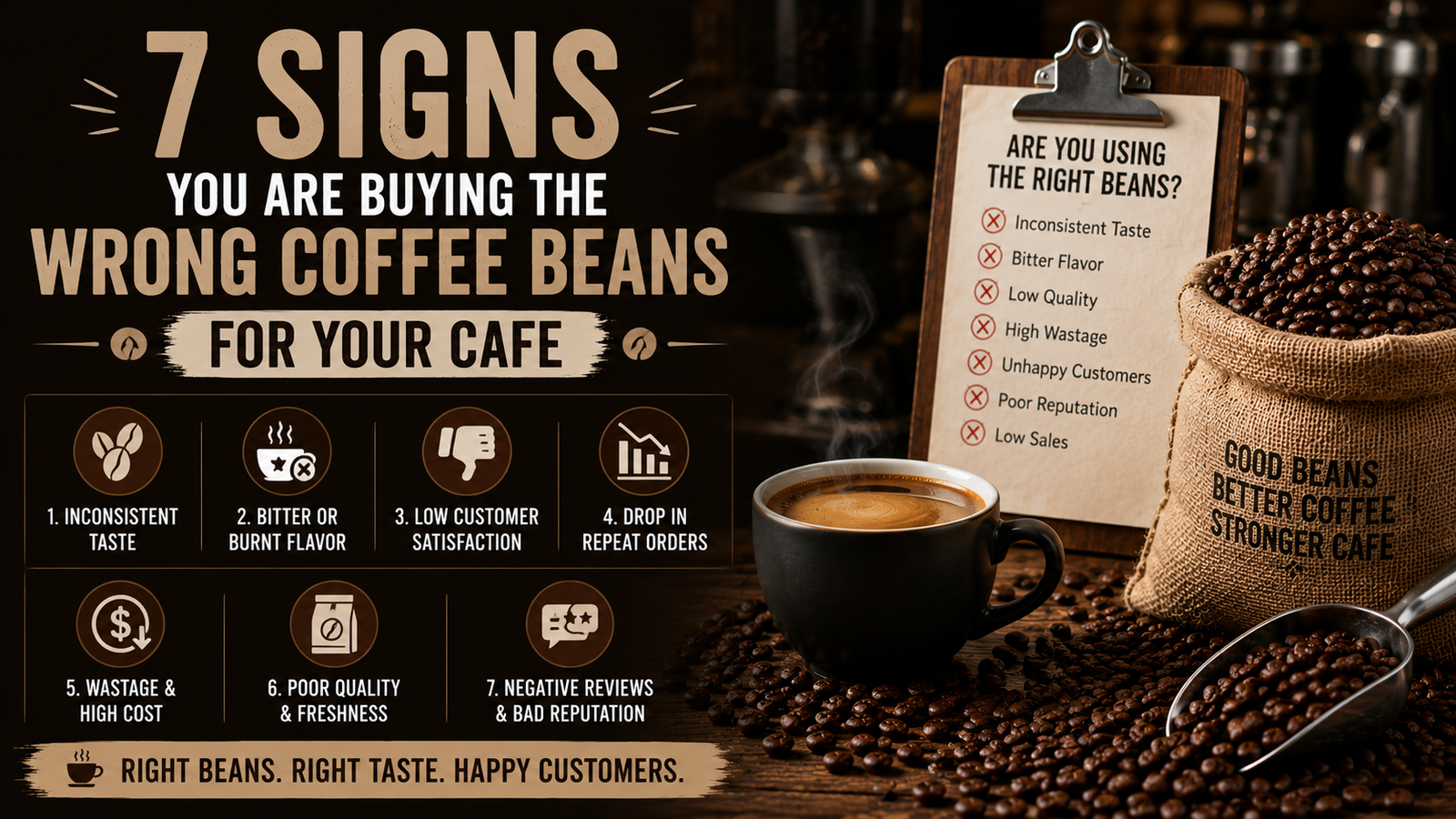
This guide lays out the 7 clearest warning signs that you are buying the wrong coffee beans for your cafe, and exactly what to do about it before it costs you more customers.
Why Getting Coffee Beans Right Matters More Than Ever
India’s cafe market has changed dramatically in the last five years. Customers in cities like Surat, Ahmedabad, Mumbai, and Bangalore are no longer comparing your coffee to nothing — they are comparing it to specialty cafes, international chains, and the excellent cups they had at a friend’s home.
The bar has risen. And the single biggest factor separating a cafe customers return to versus one they visit once and forget is the quality and consistency of the coffee. That starts entirely with the beans.
Sign 1: Your Espresso Is Consistently Bitter or Sour
This is the most direct and obvious signal, yet many cafe owners dismiss it as a machine or barista issue.
A correctly prepared espresso using the right beans should taste balanced — a gentle sweetness, a mild pleasant acidity, a clean finish, and a lingering warmth. It should not make you wince.
If your espresso is consistently bitter, your beans are likely over-roasted, stale, or sourced from a low-grade supply. Bitterness in espresso is almost always a bean problem first, not a brewing problem.
If your espresso tastes sour and thin rather than bitter, the beans may be under-developed, improperly stored, or the wrong roast level for your machine. Light-roast specialty beans need precise extraction temperatures and grind settings. If your machine is calibrated for a medium-dark commercial blend and you are using a very light roast, the result will be sharp, acidic, and unpleasant.
The fix: Match your roast level to your machine’s calibration. Ask your supplier about the roast profile before ordering. If your supplier cannot describe their roast profile, find a better supplier.
Sign 2: No One Comments on How Good Your Coffee Smells
The smell of freshly brewed coffee is one of the most powerful marketing tools a cafe has. It triggers memory, creates comfort, and draws people in from the street. When a customer walks into a great cafe, the aroma hits them before anything else.
If your cafe smells neutral — or worse, faintly stale — your beans have lost their aromatic oils. These oils are what create that warm, rich, inviting coffee fragrance. They degrade rapidly as beans age and are destroyed entirely by poor storage conditions.
Freshly roasted beans of good quality, ground right before brewing, fill the room with aroma. Stale beans of poor quality produce a flat, dead smell that no customer ever notices or comments on.
If you cannot remember the last time a customer said your coffee smelled amazing, check your beans’ roast date and storage conditions immediately.
Sign 3: Customers Regularly Add Sugar Without Tasting First
Watch your customers carefully. When someone sits down, receives their cappuccino or filter coffee, and immediately reaches for the sugar before taking a single sip — that is a conditioned behaviour. They have learned, consciously or not, that your coffee needs help.
This is one of the most reliable hidden indicators of poor coffee bean quality in an Indian cafe context. Customers who have been disappointed before protect themselves by sweetening immediately. They do not complain — they just quietly manage the experience they have learned to expect.
A cafe serving quality beans will have customers who taste first, then perhaps add a small amount of sugar. A cafe serving poor beans will have a sugar bowl that empties quickly.
Start observing this pattern at your cafe. It will tell you more about your coffee quality than any survey.
Sign 4: Your Crema Is Thin, Pale, or Disappears Quickly
Crema — the golden-brown foam that sits on top of a freshly pulled espresso — is a direct visual indicator of bean freshness. It forms because freshly roasted beans contain CO2 gas trapped inside the bean structure. When hot pressurised water passes through freshly ground coffee, this CO2 creates the rich, thick crema on top.
As beans age past their peak window, the CO2 escapes. The older the beans, the less crema they produce. Beans older than 30 to 40 days from roasting typically produce thin, pale, and rapidly disappearing crema.
If your espresso shots regularly look flat and lifeless on top, and the crema vanishes within 10 to 15 seconds, your beans are past their prime. This is true even if the best-before date on the bag says you have months remaining — best-before dates indicate safety, not peak flavour.
Always check the roast date. For espresso, peak performance is between 7 and 25 days post-roast.
Sign 5: Different Batches of the Same Coffee Taste Different
Consistency is everything in the cafe business. When a customer orders the same cappuccino they enjoyed last Tuesday and it tastes noticeably different — weaker, more bitter, or flatter — their trust in your cafe is damaged. They start to feel that you are not reliable.
If you notice that your coffee tastes great with one bag but disappointing with the next bag from the same supplier, your supplier has inconsistent quality control. This is extremely common with low-cost commercial suppliers who blend different crop batches together without maintaining consistent roast profiles.
Premium coffee suppliers roast to consistent profiles and maintain stable supply chains. When you open a new bag, the coffee should taste essentially the same as the previous bag.
Inconsistent batches are a clear sign you need a better supplier — one who takes roasting and sourcing seriously.
Sign 6: Milk-Based Drinks Taste Flat and Thin
This one surprises many cafe owners. They assume that because cappuccinos and lattes are mostly milk, the beans matter less. In reality, the opposite is true.
The espresso shot forms the foundation of every milk-based drink. It provides the bitterness, the aroma, and the flavour body that cuts through the milk and gives the drink its character. When the espresso shot is weak and flat — because the beans lack the oils, body, and intensity that good beans provide — the entire milk-based drink collapses into a cup of warm milk with a coffee flavour hint.
A strong, well-extracted espresso made from quality beans stands up to milk beautifully. A weak espresso from poor beans disappears into the milk and produces a forgettable, watery drink.
If customers are not finishing their lattes or cappuccinos, or if the drinks look pale and thin rather than rich and layered, look at your bean choice and freshness first.
Sign 7: Your Repeat Customer Rate Is Lower Than It Should Be
This is the most commercially important sign on this list. A healthy cafe should see a significant percentage of new customers return within a month. Coffee is a daily or near-daily habit for many Indians — there is no natural reason for a customer to try your cafe once and never return, unless something in the experience disappointed them.
If your new customer acquisition is reasonable but your regulars are few, the experience is failing somewhere. And if ambience, service, and pricing are not the obvious culprit, the coffee almost always is.
Track this consciously. Count how many of your customers from last month came back this month. If that number is consistently low, invest in improving your bean quality before spending another rupee on marketing or decor.
New customers are expensive to acquire. Regular customers are free. Bad coffee beans are the most efficient way to destroy the regular customer base you have worked hard to build.
What to Do Right Now: A 3-Step Fix
Step 1 — Audit Your Current Beans Today
Check the roast date on every bag of beans currently in your cafe. If you cannot find a roast date, or if the beans are more than 30 days past roasting, replace them immediately. Taste a shot of straight espresso with no milk or sugar. Be honest about what you experience.
Step 2 — Identify the Right Bean Profile for Your Menu
Match your bean variety and roast level to your drink menu and machine. If you primarily serve espresso-based drinks, you need a medium-dark Arabica-Robusta blend designed for espresso. If you serve South Indian filter coffee, you need a Robusta-forward dark roast. Ask your equipment supplier for a recommendation if you are unsure — the right machine-bean pairing makes a significant difference.
Step 3 — Source From a Reliable Supplier Who Provides Roast Dates
Work only with suppliers who can tell you exactly when their beans were roasted and maintain consistent quality between batches. A good supplier will offer samples, explain their roast profiles, and support you in finding the right product for your specific operation.
Neelkanth Enterprise supplies premium coffee beans, green coffee beans, and commercial-grade premix options to cafes and restaurants across Surat and Gujarat. We work closely with each customer to recommend the right product for their machine and menu. Contact us today to request a sample or discuss your requirements.
Conclusion
The wrong coffee beans are silently costing Indian cafe owners customers every single day. The signs are there — bitter shots, disappearing crema, customers adding sugar before tasting, inconsistent batches, low repeat visits — but they are easy to miss when you are focused on running a busy operation.
Now you know what to look for. Do the audit. Fix the sourcing. Serve a cup that brings customers back.
Because in the cafe business, a great cup of coffee is not the product you are selling. It is the reason customers come back tomorrow.