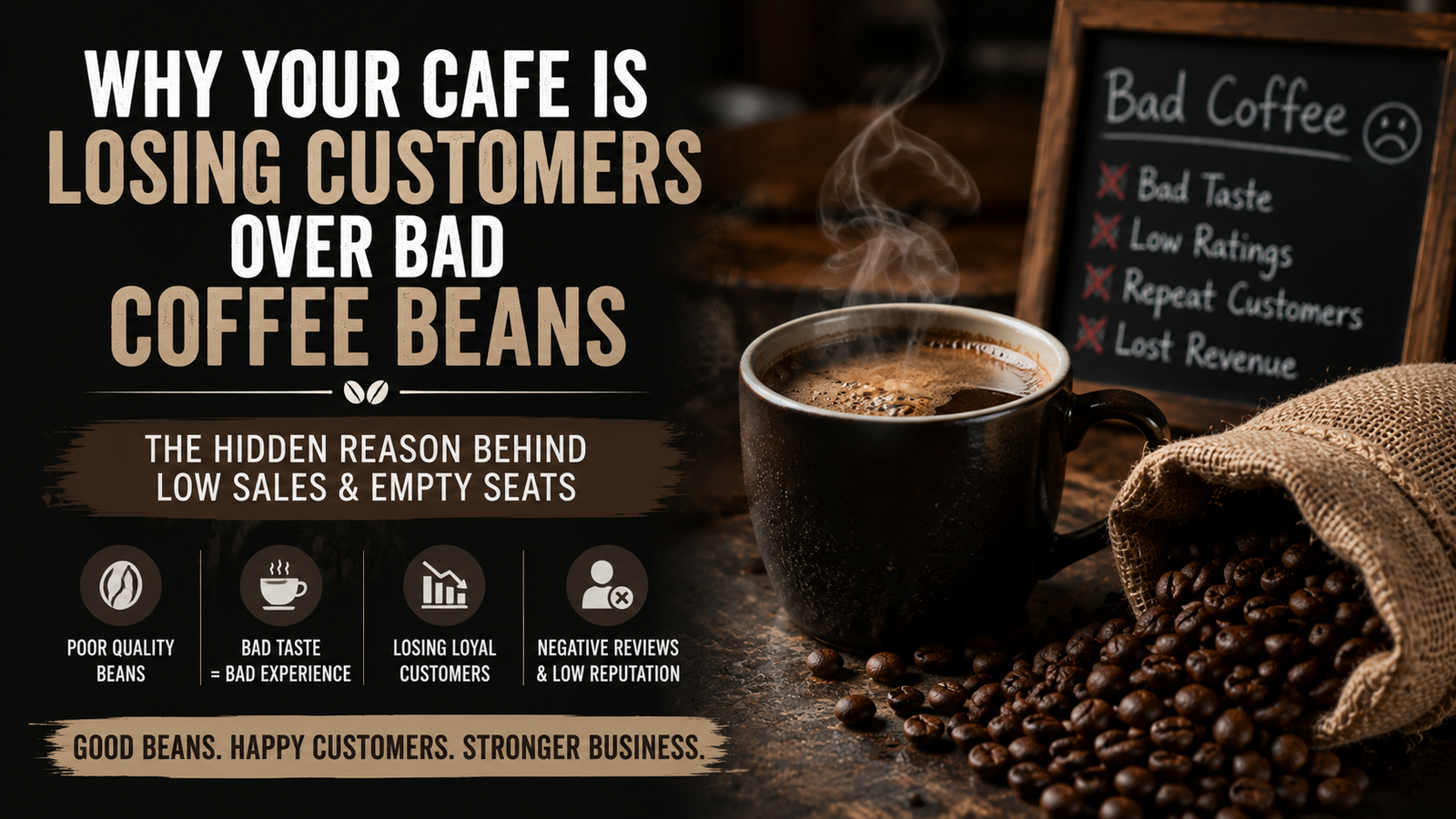
You invested in the right location. You designed a beautiful space. You hired staff who smile. Yet customers come once, enjoy the ambience, and never return. If this sounds familiar, the problem is almost certainly sitting in your coffee machine — bad coffee beans.
In India’s rapidly growing cafe culture, coffee quality is no longer a bonus. It is the baseline expectation. And bad coffee beans are the single most common reason a cafe loses loyal customers without ever knowing why.
This guide will help every cafe owner in India identify whether bad coffee beans are quietly destroying their business, and what to do about it right now.
Why Bad Coffee Beans Are a Silent Business Killer
Unlike a rude staff member or a broken air conditioner, bad coffee is a problem customers rarely complain about directly. They simply leave. They tell their friends. They post a quiet one-star review that says “average coffee.” And you never find out the real reason.
Research consistently shows that coffee quality is the number one factor driving repeat visits to a cafe. Not ambience. Not price. Not service alone. Coffee. When a customer gets a bitter, flat, or sour cup, their brain files your cafe under “not worth returning to” — and no loyalty card or discount offer can reverse that easily.
The tragedy is that in most cases, the coffee machine is perfectly fine. The barista technique is decent. The milk is fresh. The only problem is the beans — wrong variety, wrong roast date, wrong storage, wrong supplier.
7 Signs Your Cafe Is Using Bad Coffee Beans
1. Your Espresso Tastes Consistently Bitter or Sour
A well-pulled espresso shot should be balanced — slightly sweet, slightly acidic, with a clean finish. If your shots are consistently too bitter, the beans are likely over-roasted, stale, or of poor quality. If they taste sour and thin, the beans may be under-developed or improperly stored.
Bitter or sour espresso is the most immediate signal that your coffee beans are not right for your machine or your menu.
2. Your Coffee Lacks Aroma
The moment a customer walks into your cafe, the smell of freshly brewed coffee should be one of the first things they notice. If your cafe smells of nothing, or worse, smells stale and flat, your beans have lost their volatile aromatic oils — the compounds responsible for that irresistible coffee fragrance.
This usually happens when beans are too old, have been stored in a poor container, or were roasted months ago before reaching you. Fresh, quality beans release a powerful, pleasant aroma from the moment you grind them.
3. Customers Keep Asking for Extra Sugar
Pay close attention to how often customers ask for extra sugar in their coffee without tasting it first. This is a trained response — they have learned from experience that your coffee is too bitter, and they pre-emptively compensate. It is one of the clearest hidden signals that your beans are producing a harsh, unpleasant cup.
4. You Are Getting Vague Negative Reviews About “Average Coffee”
Read your Google reviews and Zomato ratings carefully. Phrases like “the coffee was okay,” “nothing special,” or “the food was good but coffee was average” are not neutral feedback. They are polite ways of saying the coffee disappointed. In India’s cafe scene, “average” coffee means customers will find somewhere better next time.
5. Your Coffee Crema Is Thin, Pale, or Disappears Instantly
Good espresso should produce a thick, caramel-coloured crema that sits on top of the shot and lasts for at least 30 to 60 seconds. If your crema is thin, pale yellow, or vanishes within seconds, your beans are likely stale. Crema is produced by CO2 trapped inside fresh roasted beans — as beans age, they lose this gas and the crema disappears.
This is a clear, visible sign that your beans are past their prime, even if the roast date printed on the bag looks acceptable.
6. Your Repeat Customer Rate Is Low
If most of your customers come once and do not return, and your service and ambience are solid, the problem is almost always in the cup. Track your repeat customer rate consciously. A healthy cafe should see 30 to 50 percent of customers returning within a month. If that number is consistently below 20 percent, your coffee is likely not making the impression it should.
7. Different Bags of the “Same” Coffee Taste Inconsistent
If you notice that one batch of coffee tastes reasonable but the next bag from the same supplier tastes noticeably different — flatter, more bitter, or weaker — your supplier has inconsistent quality control. This inconsistency is one of the most damaging things for a cafe, because customers who experienced a good cup will return expecting the same and leave disappointed.
The Most Common Causes of Bad Coffee Beans in Indian Cafes
Buying on Price Alone
The cheapest coffee beans are cheap for a reason. Low-grade beans from unreliable sources are often a mix of different harvests, inconsistently roasted, and stored for long periods before reaching the buyer. The per-kilo saving looks attractive but the cost in lost customers is far higher.
Many cafe owners in Surat and across Gujarat make this mistake when first opening. The math seems to work — cheaper beans, lower cost per cup, better margins. But when repeat customers drop and ratings suffer, the true cost of cheap beans becomes apparent.
Ignoring the Roast Date
Freshly roasted coffee beans have a peak flavour window. Espresso beans perform best between 7 and 21 days after roasting. After 30 days, the CO2 embedded in the beans begins to escape, crema weakens, aroma fades, and the cup becomes flat and lifeless.
Most commercial packaging shows a best-before date that is 12 to 18 months from roasting. This does not mean the beans taste good for 18 months — it means they are safe to consume. Flavour peaks in the first three weeks and declines steadily after 30 days.
Always ask your supplier for the roast date, not just the expiry date. If your supplier cannot or will not tell you the roast date, that is a serious warning sign.
Wrong Bean Variety for the Drink Menu
Arabica and Robusta beans behave very differently in a coffee machine. Light-roast specialty Arabica beans designed for pour-over or filter coffee will produce a thin, acidic, unpleasant shot when forced through an espresso machine calibrated for a medium-dark blend.
Many cafe owners choose beans based on how they sound on a menu — “single-origin Ethiopian Arabica” sounds impressive — without matching the bean profile to their actual drink menu and machine settings. The result is technically premium beans delivering a poor cup.
Poor Storage at the Cafe
Even excellent beans become bad beans within days if stored incorrectly. Exposure to air, light, heat, and moisture accelerates staling dramatically. Beans stored in open bags, glass jars on countertops, or near ovens and dishwashers lose their flavour far faster than beans should.
Always store whole beans in airtight, opaque containers away from heat sources. Never store beans in the refrigerator — the moisture causes them to absorb other flavours and degrade rapidly.
Using Pre-Ground Coffee
Pre-ground coffee begins staling within 15 minutes of grinding. The volatile aromatic compounds that give coffee its character begin escaping the moment the grind structure is broken. Buying pre-ground coffee for your espresso machine is one of the easiest ways to ensure mediocre cups regardless of how good the original beans were.
If your machine has an integrated grinder, always buy whole beans and grind fresh per order.
How to Fix the Problem: Choosing the Right Coffee Beans for Your Cafe
Step 1: Define Your Drink Menu First
Your bean choice must follow your menu, not the other way around. If you serve South Indian filter coffee, you need a Robusta-dominant dark roast. If you serve espresso-based drinks — cappuccino, latte, flat white — you need a medium-dark Arabica-Robusta blend. If you serve specialty pour-over or cold brew, a lighter Arabica single-origin works well.
Trying to serve all of these with one bean is a compromise that produces mediocre results across the board. Many successful cafes in Surat use two different beans — one blend for espresso-based drinks and one origin for specialty filter options.
Step 2: Always Check the Roast Date
Before placing any order, confirm the roast date with your supplier. Aim to use beans within 7 to 28 days of roasting for espresso. For filter coffee, a slightly wider window of up to 35 days is acceptable.
Build your ordering frequency around this window. Ordering in smaller quantities more frequently is better than buying in bulk and letting beans go stale in storage.
Step 3: Run a Taste Test Before Committing
Any reputable coffee supplier should be willing to provide samples before a bulk order. Brew the sample beans on your actual machine at your standard settings. Taste them black first — black coffee reveals the true character of the bean without milk or sugar masking problems. Only commit to a supplier whose beans pass your taste test.
Step 4: Match Your Machine to Your Beans
Talk to your equipment supplier about which bean profiles work best with your specific machine model. Commercial automatic espresso machines are typically calibrated for medium-dark roast blends. Very light roasts may require adjustments to grind size, dose, and extraction time to produce a good result.
At Neelkanth Enterprise, we always help our customers match the right coffee beans and premix options to the exact machines we supply — because a great machine with the wrong beans still produces a poor cup.
Step 5: Invest in Proper Storage Equipment
Purchase airtight, opaque coffee storage containers for your cafe counter. If you buy in larger quantities, store the bulk in a cool, dark cupboard and only transfer a few days’ supply to the counter container at a time. Label each container with the roast date so staff can monitor freshness.
The Business Case for Upgrading Your Coffee Beans
Let us put numbers to this. A typical espresso-based drink in a Surat cafe sells for ₹120 to ₹200. Upgrading from a low-grade bean at ₹400 per kg to a quality blend at ₹900 per kg might increase your cost per cup by ₹4 to ₹6.
If that upgrade brings in just 10 additional repeat customers per week — customers who would have churned with poor coffee — at an average spend of ₹200 per visit, that is ₹2,000 additional weekly revenue against a ₹500 to ₹700 increase in weekly bean cost. The return on investment is immediate and significant.
Good coffee beans are not a cost. They are an investment in customer retention — the most valuable asset any cafe has.
Conclusion
Bad coffee beans are the silent enemy of cafe growth in India. They cost you customers without ever triggering a complaint you can respond to. They undermine your staff’s efforts, your location investment, and your brand reputation — one disappointing cup at a time.
The solution is straightforward: know your menu, demand fresh beans with a verified roast date, match your bean variety to your machine, and source from a supplier who understands both coffee and commercial kitchen equipment.
Neelkanth Enterprise supplies premium coffee beans, green coffee beans, and commercial-grade premix powders to cafes and restaurants across Surat and Gujarat. Contact us today to discuss your requirements, request a sample, or explore our full range of coffee solutions.
Your customers deserve a great cup. Give them a reason to come back.