There is no shortage of advice on coffee beans online. But most of it is written for home brewers, specialty enthusiasts, or roasters — not for cafe owners and restaurant operators in India who need to serve consistent, excellent coffee at volume, every single day, within a real budget.
This guide is written specifically for you. Whether you are opening your first cafe in Surat, scaling a restaurant chain across Gujarat, or simply trying to make smarter purchasing decisions for your existing operation, everything you need to know about buying coffee beans is here in one place.
Why Coffee Bean Knowledge Is a Business Skill, Not Just a Food Skill
The average cafe in India serves between 50 and 300 cups of coffee per day. At that volume, every small decision about beans — variety, roast level, freshness, sourcing — multiplies into thousands of cups and lakhs of rupees in annual revenue impact.
A cafe owner who understands coffee beans makes better purchasing decisions, wastes less product, serves more consistent cups, and keeps more customers coming back. A cafe owner who treats coffee beans as a generic commodity — buying whatever is cheapest or most familiar — is leaving both quality and money on the table.
This guide gives you the knowledge to make every bean decision with confidence.
Part 1: Understanding Coffee Bean Varieties
Arabica
Arabica is the most widely grown and consumed coffee variety in the world, accounting for around 60 percent of global production. In India, Arabica is grown primarily in Karnataka — particularly in Coorg and Chikmagalur — as well as in Kerala and Tamil Nadu.
Arabica beans grow at higher elevations, which slows their development and allows more complex sugars and acids to form. The result is a smoother, more nuanced cup with lower bitterness, mild to medium acidity, and flavour notes that range from fruity and floral to chocolatey and nutty depending on the origin.
Arabica beans are more delicate, more expensive, and more sensitive to heat and storage conditions than Robusta. They are the right choice for specialty menus, pour-over offerings, cold brew, and espresso-based drinks where flavour complexity is the selling point.
Price range in India (2025): ₹600 to ₹2,500 per kg depending on grade and origin.
Best for: Specialty espresso, filter coffee, pour-over, cold brew, flat whites, and lattes where flavour clarity matters.
Robusta
Robusta is India’s other major coffee variety, grown heavily in Kerala, Karnataka, and Andhra Pradesh. India is one of the world’s leading Robusta exporters, producing beans that are well-regarded in the international market.
Robusta beans contain nearly twice the caffeine of Arabica. They grow at lower elevations, are more resistant to disease and pests, and produce a higher yield per plant — which is why they cost significantly less. The flavour profile is bold, earthy, and straightforwardly bitter, with less acidity and complexity than Arabica.
Robusta is the backbone of commercial espresso blends worldwide because it produces thick, stable crema and provides a strong, bold base that cuts through milk effectively. It is also essential in traditional South Indian filter coffee, where its strength and body are not a compromise but a feature.
Price range in India (2025): ₹250 to ₹700 per kg.
Best for: South Indian filter coffee, high-volume espresso blends, commercial cappuccinos and lattes, any application where strength, body, and cost efficiency are priorities.
Arabica-Robusta Blends
The majority of commercial cafes in India — and most cafes worldwide — use a blend of Arabica and Robusta rather than a single variety. A well-designed blend captures the smooth complexity of Arabica and the body, crema, and cost efficiency of Robusta.
A typical commercial espresso blend is 60 to 70 percent Arabica and 30 to 40 percent Robusta. The exact ratio varies based on the flavour profile desired and the price point targeted.
Best for: High-volume cafes serving a full espresso menu — cappuccinos, lattes, Americanos, cold coffees. The blend format offers the best balance of quality, consistency, and cost for most Indian cafe operations.
Liberica and Excelsa
These are minor varieties that account for a small fraction of global production. Liberica has a distinctive woody, smoky flavour and is occasionally found in specialty markets. Excelsa is grown in parts of South and Southeast Asia and is sometimes used in blends. For most commercial cafe purposes in India, these varieties are not relevant purchasing considerations.
Part 2: Understanding Roast Levels
The same bean tastes dramatically different depending on how it is roasted. Roast level is one of the most important variables in your bean purchasing decision, and it must align with your drink menu and equipment.
Light Roast
Light roasting stops early, preserving the original character of the bean — its fruit acids, floral notes, and origin-specific flavours. Light roast beans are tan to medium brown, have no surface oil, and are harder in texture.
Light roasts are best suited for filter coffee, pour-over, and cold brew methods where water passes slowly through the grounds and extracts delicate flavours. They are NOT suitable for most commercial automatic espresso machines, which are calibrated for medium to dark roast profiles. Using a light roast in an espresso machine without adjusting extraction parameters results in a sour, under-extracted shot.
Medium Roast
Medium roast beans are the sweet spot for most espresso-based menus. The roasting process has developed enough sugars and oils to produce good crema and body, while retaining enough of the bean’s character to deliver flavour complexity in the cup.
Medium roast Arabica blends are the most widely used commercial coffee product in Indian specialty cafes. If you are unsure where to start, a quality medium roast Arabica-Robusta blend is almost always the right answer for a standard espresso menu.
Medium-Dark Roast
At this roast level, some oils begin to appear on the bean surface. Bitterness increases, acidity decreases, and the flavour becomes richer and more robust. Medium-dark roasts are excellent for milk-based drinks — the bold flavour stands up well to the milk and produces a satisfying, strong cup without being harsh.
This is the most popular roast level for high-volume cafes across India serving cappuccinos, lattes, and cold coffees.
Dark Roast
Dark roast beans are oily, dark brown to near-black, and have a dominant bitter, smoky, roasted flavour. Most of the bean’s origin character has been driven off by the extended roasting. Dark roasts are the traditional choice for South Indian filter coffee and traditional espresso styles where strength and boldness are the primary qualities desired.
Dark roasted beans stale faster than lighter roasts due to the surface oils, so freshness and storage are especially important at this roast level.
Part 3: Indian Coffee Origins Worth Knowing
Understanding where your coffee comes from helps you make more informed purchasing decisions and gives you authentic menu storytelling that resonates with increasingly knowledgeable Indian customers.
Coorg (Kodagu), Karnataka
Coorg is widely considered the home of India’s finest Arabica. Grown at elevations of 900 to 1,500 metres under shade trees in a biodiverse forest environment, Coorg Arabica is known for its clean, balanced profile with mild acidity, medium body, and a smooth, pleasant finish. It is the premium choice for specialty espresso menus.
Chikmagalur, Karnataka
Historically celebrated as the birthplace of Indian coffee cultivation, Chikmagalur produces both Arabica and Robusta of consistent high quality. Chikmagalur Arabica tends toward a chocolatey, slightly fruity profile with good body — an excellent commercial espresso bean that balances quality with accessible pricing.
Wayanad, Kerala
One of India’s largest coffee-producing districts, Wayanad produces substantial volumes of both Arabica and Robusta. Wayanad beans are bold and earthy, with strong body — particularly well-suited for South Indian filter coffee blends and commercial espresso applications.
Araku Valley, Andhra Pradesh
Araku has gained remarkable international recognition in recent years, winning awards at specialty coffee events in Paris and London. Tribal farming communities grow organic Arabica at high elevations, producing complex, floral, fruit-forward beans. Araku commands premium pricing and is best suited for specialty single-origin offerings where the story and flavour complexity justify a higher menu price.
Nilgiris, Tamil Nadu
The Blue Mountains of Tamil Nadu produce Arabica with a bold, distinct character and bright acidity. Nilgiri coffee is a strong, flavourful choice that works well in South Indian blends and traditional filter coffee preparations.
Part 4: Matching Beans to Your Cafe Menu
This is the most practically important section in this guide. The wrong bean in the right machine, or the right bean in the wrong machine, both produce poor results. The goal is alignment.
For a Standard Espresso Menu
If your menu centres on cappuccino, latte, flat white, Americano, and cold coffee, you need a medium to medium-dark roast Arabica-Robusta blend, dosed between 18 and 21 grams per double shot, with beans roasted within the last 7 to 25 days.
This is the configuration that performs best in commercial automatic espresso machines across all volume levels. The blend ratio gives you the crema and strength of Robusta with the flavour nuance of Arabica, producing a consistently satisfying cup that works equally well with and without milk.
For South Indian Filter Coffee
South Indian filter coffee demands a Robusta-dominant dark roast, often blended with a small percentage of chicory in the traditional style. The preparation method — slow drip through a metal filter, mixed with hot milk — requires bold, strong beans that can hold their character through the extraction process.
If you offer both espresso-based drinks and filter coffee, these require different beans. Running one bean through both systems is a compromise that weakens both offerings.
For Specialty or Pour-Over Options
If your menu includes specialty filter offerings — pour-over, Chemex, AeroPress, or cold brew — a light to medium roast single-origin Arabica is the right choice. Coorg, Araku, or Chikmagalur origins all work well in this context.
Keep these beans separate from your espresso supply and order in smaller quantities given their more limited demand in most Indian cafes.
Part 5: The Freshness Factor — What Every Cafe Owner Must Know
Freshness is the variable that most distinguishes an excellent cup from an average one, and it is the variable most commonly neglected in commercial cafe purchasing.
Roasted coffee beans begin changing the moment roasting ends. CO2 gas, produced during roasting, is trapped inside the bean structure. As the beans rest and degas over the first 3 to 7 days post-roast, they reach their flavour peak. Between 7 and 25 days post-roast, espresso beans perform at their best. After 30 days, flavour begins to diminish noticeably. After 45 to 60 days, crema weakens significantly and the cup becomes flat.
The best-before date printed on most commercial coffee bags is 12 to 18 months from roasting. This date indicates food safety, not flavour quality. Do not use it as your freshness benchmark.
Always ask your supplier for the roast date. Order quantities you can use within 20 to 25 days of the roast date. Establish a regular ordering rhythm that ensures fresh stock arrives before your current supply crosses the 30-day threshold.
Part 6: Storage — Protecting the Quality You Paid For
Even the freshest, highest-quality beans become ordinary coffee if stored incorrectly. The four enemies of roasted coffee are air, light, heat, and moisture. All four degrade the volatile compounds responsible for aroma, flavour, and crema.
Store your beans in airtight, opaque containers with a one-way CO2 valve — this allows the ongoing degassing from fresh beans to escape without letting outside air in. Keep containers away from your espresso machine, oven, dishwasher, and any window that receives direct sunlight.
Transfer only 2 to 3 days of supply to your counter-level working container at a time. Keep the remainder sealed and stored in a cool, dark location. Never refrigerate roasted coffee beans — the moisture in a refrigerator accelerates staling and causes the beans to absorb other food odours.
Part 7: Finding the Right Supplier
The supplier relationship is as important as the product itself. A good coffee bean supplier does more than ship bags of beans. They provide roast date transparency, consistent quality between batches, appropriate product recommendations for your specific setup, and responsive service when your requirements change.
When evaluating any new coffee bean supplier, ask these questions before placing your first order. When were these beans roasted? What is the roast profile? Can I request a sample before committing to bulk? What is the minimum order quantity and turnaround time for fresh stock? Will quality and roast profile be consistent between batches?
Any supplier who cannot or will not answer these questions clearly is not the right partner for your cafe.
Neelkanth Enterprise supplies premium coffee beans, green coffee beans, and commercial-grade premix options to cafes, restaurants, and hotels across Surat and Gujarat. We provide full roast date transparency, consistent batch quality, and personalised recommendations based on your machine, your menu, and your volume. Contact us today to request a sample or discuss your requirements.
Quick Reference: Coffee Bean Buying Checklist
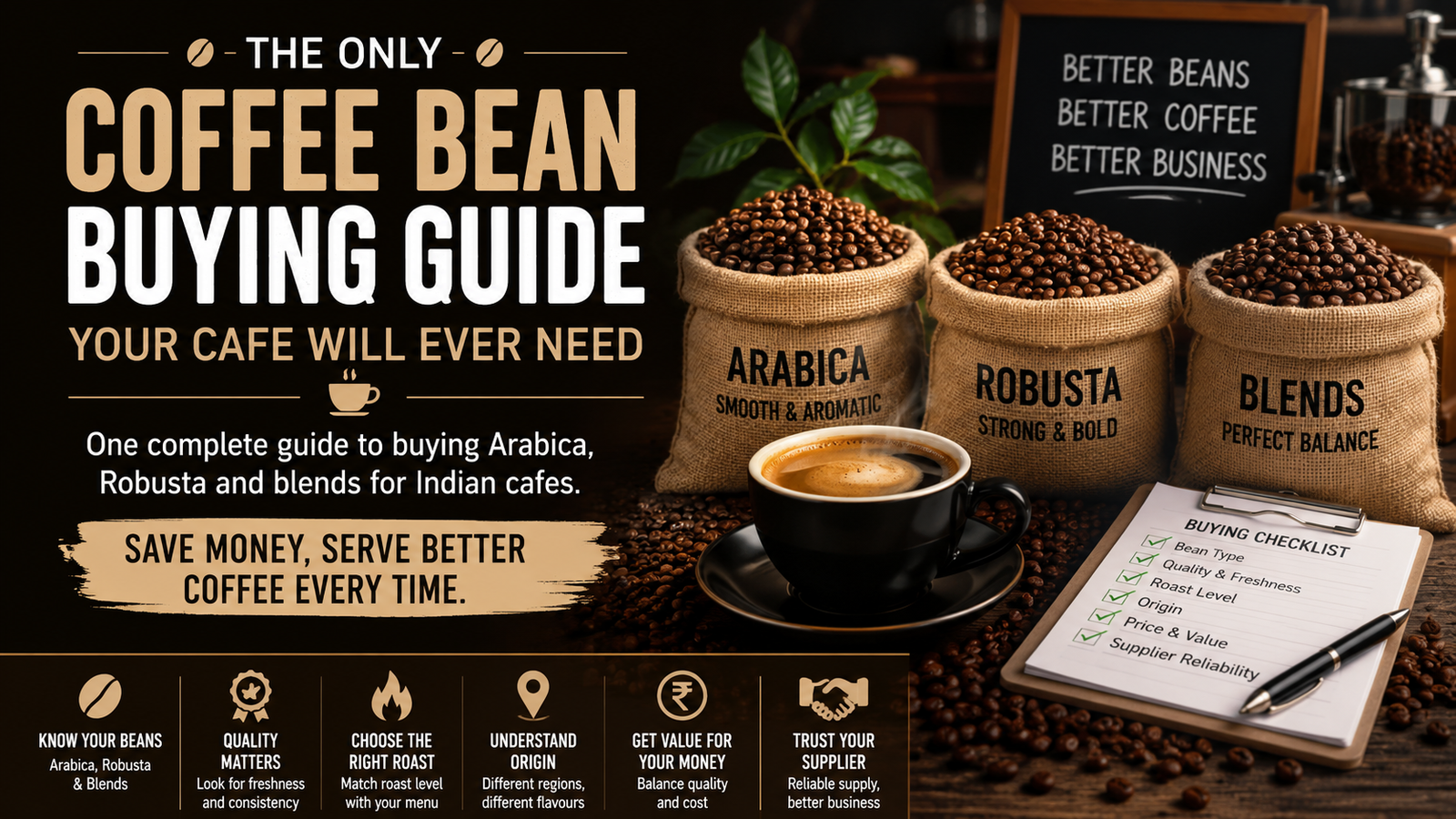
Before placing any coffee bean order, confirm the following. You know the roast date and it falls within your freshness window. The roast level matches your machine’s calibration and your drink menu. The variety or blend ratio suits your primary drink offerings. You have calculated your realistic cost per cup, not just cost per kilogram. You have airtight storage containers ready. Your order quantity matches what you can use within 20 to 25 days of the roast date.
Conclusion
Buying coffee beans well is not complicated once you understand the variables. Know your variety. Match your roast level to your machine and menu. Prioritise freshness over bulk savings. Store correctly. And work with a supplier who treats your operation as a partner, not just a transaction.
Apply this guide to every purchasing decision you make, and your cafe will serve better coffee, waste less product, and retain more of the customers who walk through your door.