
Every coffee supplier in India will tell you their beans are fresh, their quality is the best, and their price is fair. Most of them are not lying exactly — but they are also not telling you everything you need to know to make a genuinely informed buying decision.
The Indian coffee supply chain has layers of complexity that most cafe owners never see. Roast dates get obscured. Blend ratios get misrepresented. Pricing structures reward loyalty in ways that are never made transparent. And the specialty coffee vocabulary that has exploded in the last five years gets used to justify premium pricing on products that do not always deserve it.
This guide pulls back the curtain. If you own or manage a cafe or restaurant in India and you buy coffee beans, these are the things your suppliers hope you never find out.
The Truth About Roast Dates
Let us start with the most important and most consistently hidden piece of information in the Indian coffee supply chain: when the beans were actually roasted.
Walk into any supermarket or online coffee store in India and look at the packaging. You will almost always find a best-before date — typically 12 to 18 months from the date of manufacture. What you will almost never find printed prominently is the actual roast date.
This is not an accident. Roasted coffee beans begin losing their peak flavour quality within 30 days of roasting. By 45 to 60 days, the aromatics are noticeably diminished. By 90 days, you are brewing with beans that are technically safe to consume but have lost much of what made them worth buying. The 12 to 18 month best-before date is a food safety standard, not a freshness standard.
Suppliers and distributors benefit from this confusion because it allows them to move older stock at full price. A bag of beans roasted four months ago looks identical on the shelf to a bag roasted two weeks ago. The only way to tell the difference is the roast date — which most suppliers are not eager to shout about.
What to do: Always ask your supplier directly for the roast date, not the best-before date. A quality supplier will give you this information immediately and confidently. A supplier who deflects, provides only the best-before date, or claims roast date information is unavailable is telling you something important about the freshness of their product.
For espresso, your beans should be roasted within the last 7 to 25 days. For filter coffee, up to 35 days post-roast is acceptable. Anything beyond that is a compromise you are paying full price for.
The Blend Ratio Secret
Most commercial coffee blends sold to cafes in India are marketed with a named ratio — 70 percent Arabica, 30 percent Robusta is a common example. The problem is that nobody is verifying these ratios independently, and they can shift batch to batch based on crop availability, pricing pressures, and supplier margin decisions.
Arabica and Robusta prices fluctuate significantly across harvests. When Arabica prices spike — as they have at several points in the last decade — a blend nominally described as 70/30 Arabica-Robusta may quietly become 55/45 or even 50/50 without any change in packaging or communication to the buyer.
The result is that the coffee you ordered this month may taste noticeably different from what you ordered last month, even though it arrived in an identical bag with an identical label. Customers will notice — even if they cannot articulate exactly what has changed.
This is not universal. Reputable suppliers with rigorous quality control maintain consistent blend ratios regardless of price fluctuations, absorbing the margin impact rather than passing it to the buyer invisibly. But inconsistent suppliers are common, particularly at the lower to mid-price range.
What to do: If you notice inconsistency in your coffee quality between batches, ask your supplier directly whether the blend ratio has changed. Document your coffee quality over time — keep tasting notes batch by batch. And when evaluating a new supplier, ask how they manage blend consistency when input prices change. The answer will tell you a great deal about their operation.
Single-Origin Claims Are Not Always What They Seem
The phrase single-origin has become one of the most powerful marketing terms in the Indian specialty coffee boom. It suggests a direct, traceable connection between the cup and a specific farm or region — implying higher quality, more careful production, and a more authentic experience.
The reality is more complicated. Single-origin on a bag means the beans came from one origin — but origin can mean a country, a region, a cooperative, or a specific farm, and the gap in quality between these levels is enormous. Indian beans labelled Karnataka origin could come from thousands of different farms across a region the size of a small European country, with wildly varying quality standards.
True single-origin specialty coffee — traceable to a specific estate, with documented processing methods and quality certifications — is meaningfully different from beans that simply happen to have come from one country. But both can be labelled single-origin on a bag.
This matters because single-origin labels frequently command a 30 to 80 percent price premium over comparable blended beans. In some cases, that premium is fully justified by genuine quality and traceability. In many others, it is primarily a marketing premium on beans that taste no better than a well-sourced commercial blend.
What to do: When a supplier charges a significant premium for single-origin beans, ask for specifics. Which estate or cooperative did these beans come from? What is the altitude? What processing method was used? What cupping score was achieved? A supplier who can answer these questions in detail is selling you genuine specialty coffee. A supplier who gives vague regional answers is selling you a marketing story.
The Organic Premium Trap
Organic certification has become another premium pricing lever in the Indian coffee market. Organic certified beans typically sell at a 20 to 50 percent premium over non-certified equivalents. In some cases, the quality difference justifies the price. In many cases, it does not.
Here is what the organic label actually tells you: the beans were grown without synthetic pesticides or fertilisers, and the farm has paid for third-party certification to verify this. It does not tell you anything about flavour quality, roast freshness, or whether the beans are actually better for your cafe’s coffee.
India produces a significant volume of genuinely excellent organic coffee — particularly from tribal farming cooperatives in Araku Valley and certified estates in Coorg. But not all beans wearing the organic label come from quality-focused operations. Organic certification covers the farming method, not the flavour outcome.
What to do: Taste before you pay the premium. An organic bean that tastes flat, inconsistent, or poorly roasted is not worth the certification markup. An organic bean that genuinely shines in your cup at a reasonable premium is absolutely worth supporting. The cup is the test, not the label.
What Suppliers Do Not Tell You About Green Coffee Beans
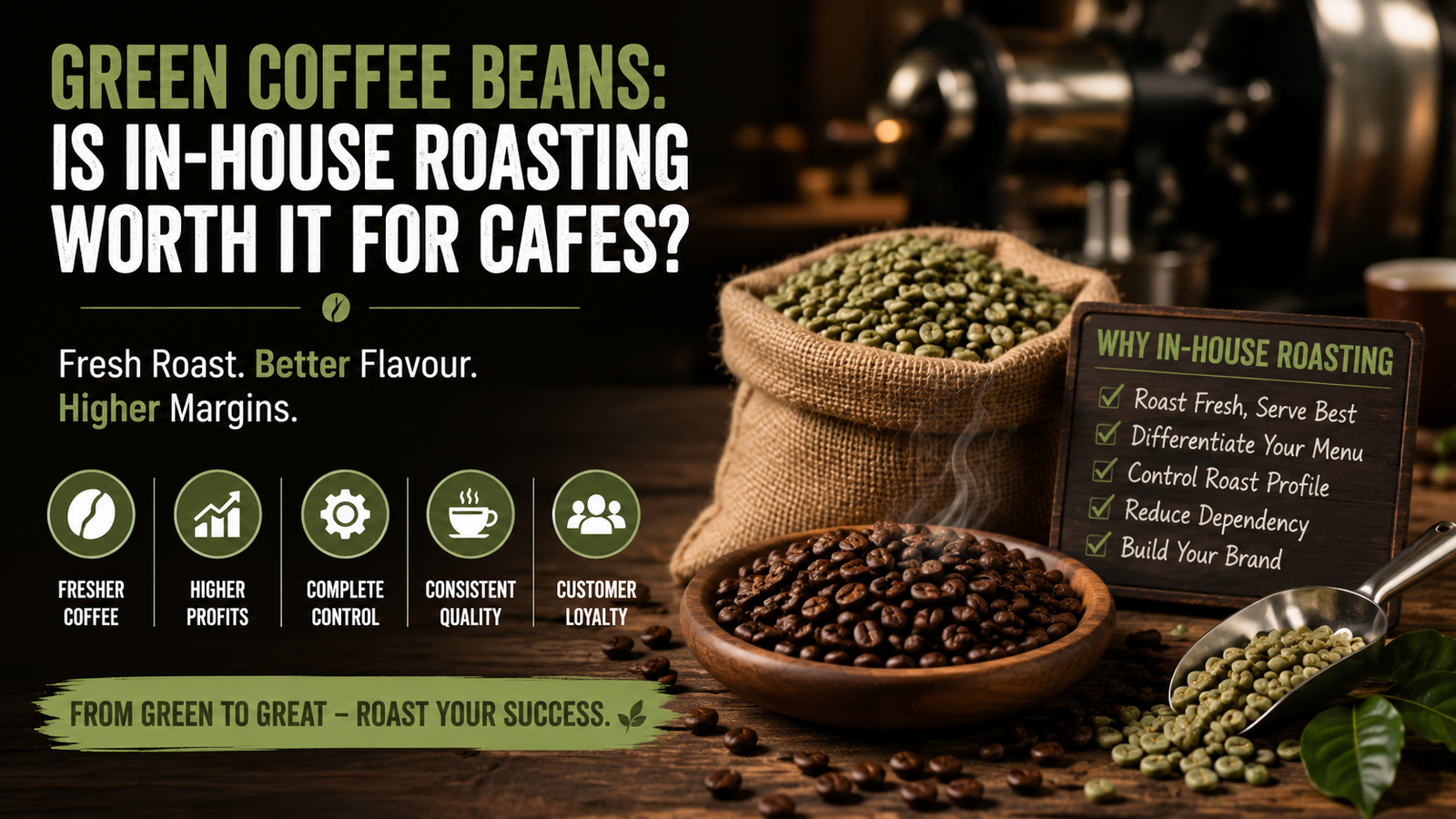
Green coffee beans — unroasted raw beans — are available from Indian suppliers at a fraction of the price of pre-roasted beans. The gap can be substantial: green Arabica that would sell as roasted beans for ₹1,200 per kg might be available raw for ₹400 to ₹600 per kg.
This looks like a massive opportunity for cost-conscious cafe owners. And for the right operation, it genuinely is. But what suppliers selling green beans rarely explain clearly is the full requirement involved in roasting in-house.
Roasting coffee beans consistently to a specific profile is a skilled process that requires dedicated equipment, significant practice, careful monitoring of time and temperature, and ongoing quality control. A home drum roaster costs ₹15,000 to ₹50,000. A commercial-grade fluid bed or drum roaster capable of consistent production for a cafe starts at ₹1.5 to ₹3 lakh or more. And the first several months of roasting typically involve significant learning waste as the operator develops their skill.
Green beans also have a much longer storage life than roasted beans — up to 12 to 18 months if stored correctly — which is a genuine advantage. But the cost of the roasting setup, the time investment, and the quality risk during the learning curve mean that in-house roasting only makes financial sense at sufficient volume and when the cafe’s brand is built around the roasting process itself.
What to do: Do not buy green beans assuming you can simply roast them at home and save money. Evaluate the full cost of roasting equipment, your time, and the learning curve honestly. If you have the volume, the equipment, and the commitment, green beans are an excellent long-term strategy. If you do not, pre-roasted beans from a reliable fresh-roasting supplier are the smarter choice.
The Delivery Lag Nobody Warns You About
When you order coffee beans from an online supplier or a distributor based in another city, the transit time between roasting and delivery is rarely communicated clearly.
A bag of beans roasted in Bengaluru or Coorg may take 3 to 7 days to reach a cafe in Surat or Ahmedabad depending on the logistics provider. If those beans were already 10 days post-roast when they left the warehouse, they arrive at your cafe at 13 to 17 days old. Your usable freshness window is already significantly reduced before you have even opened the bag.
This is one of the most practical arguments for sourcing from local or regional suppliers. A supplier based in Surat who maintains fresh-roasted stock can deliver beans within 1 to 2 days of roasting, giving you a significantly longer usable freshness window with the same order frequency.
What to do: When evaluating any supplier, ask about the typical roast-to-delivery timeline. Factor delivery days into your freshness calculation, not just the roast date. A supplier who roasts 3 to 4 days before your delivery date effectively gives you a much shorter quality window than their roast date alone suggests.
The Volume Discount Illusion
Bulk pricing is offered by almost every coffee bean supplier in India. Buy 10 kg and pay less per kilogram than buying 2 kg. The discount is real — but so is the hidden cost.
As discussed earlier in this guide, roasted coffee beans have a peak quality window of 7 to 25 days for espresso. Buying 10 kg when your weekly consumption is 2 kg means you are using beans for 5 weeks. The final 2 to 3 kg of that bulk purchase will be 35 to 45 days post-roast — past their peak quality window regardless of how well you store them.
The discount you received on the bulk purchase may cost you more in cup quality, customer dissatisfaction, and potential repeat business loss than you saved on the per-kilogram price. The math rarely favours bulk purchases for most cafe sizes unless the cafe volume is high enough to consume the entire batch within the freshness window.
What to do: Calculate your weekly bean consumption precisely. Order the quantity you can realistically use within 20 days of roasting, at your actual consumption rate. Negotiate better pricing with your supplier based on frequency and loyalty, not bulk volume. A standing weekly order of the right quantity is more valuable to most suppliers than an occasional large order — and you can often negotiate comparable pricing for reliable regular orders.
Finding a Supplier You Can Actually Trust
After reading everything above, the profile of a trustworthy coffee bean supplier in India becomes clear. They provide roast dates readily and without prompting. They maintain consistent blend ratios across batches. They are specific and honest about origin claims. They understand the difference between freshness marketing and genuine freshness. They factor delivery timelines into their freshness promises. And they are willing to provide samples before you commit to any new product.
This level of transparency is not universal in the Indian market, but it is not rare either. It is the standard that quality-focused suppliers hold themselves to, because they know that cafe owners who understand coffee will only return to suppliers who earn their trust.
Neelkanth Enterprise operates on exactly this basis. We supply coffee beans, green coffee beans, and commercial premix to cafes and restaurants across Surat and Gujarat with full roast date transparency, consistent quality between batches, and honest product recommendations based on your specific machine and menu. Contact us today to request a sample or discuss your requirements.
Conclusion
The Indian coffee bean market rewards informed buyers. Understanding roast dates, blend consistency, origin claims, and the real economics of bulk purchasing gives you the knowledge to make purchasing decisions that actually improve your cafe’s cup quality and protect your margins.
Your supplier should be a partner, not a puzzle to decode. Ask the right questions, demand the right information, and hold your supplier to the transparency standard your business deserves.