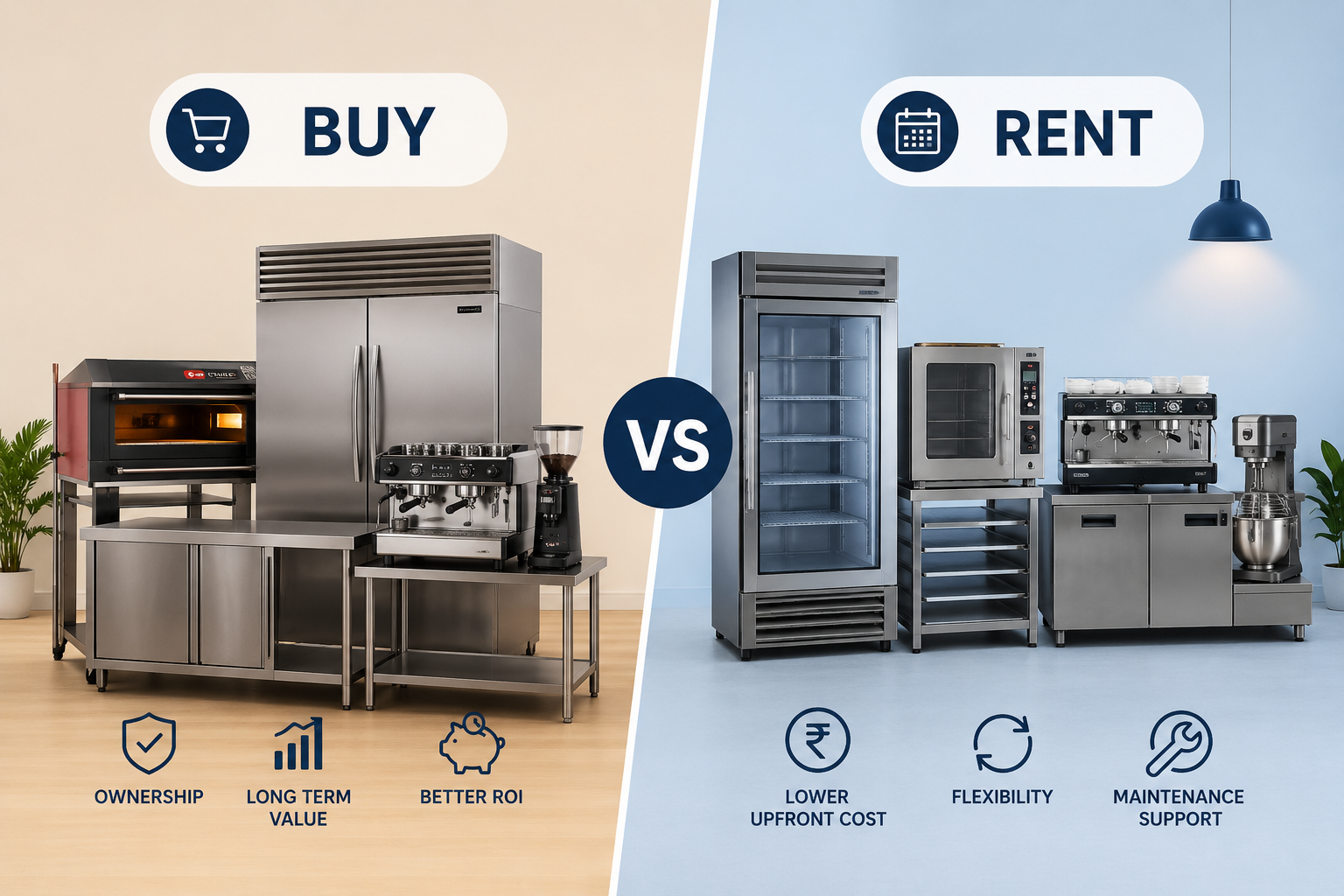
One of the biggest decisions new restaurant, cafe, bakery, cloud kitchen, and food business owners face is whether to buy commercial kitchen equipment or rent it.
At first glance, renting appears attractive because it requires less upfront investment. Buying, however, offers long-term ownership and better returns over time.
The correct choice depends on your budget, business goals, growth plans, and equipment requirements.
In this guide, we’ll compare buying versus renting commercial kitchen equipment in India and help you determine which option makes the most financial sense for your business in 2026.
Why This Decision Matters
Kitchen equipment often represents one of the largest startup expenses.
Typical equipment investments include:
- Commercial coffee machines
- Pizza ovens
- Refrigerators
- Freezers
- Dough mixers
- Cooking ranges
- Food processors
Making the wrong decision can affect:
- Cash flow
- Profitability
- Expansion plans
- Equipment reliability
That’s why evaluating both options carefully is important.
What Does Buying Equipment Mean?
When you buy equipment, you become the owner.
You pay either:
- Full upfront cost
- Loan financing
- Equipment financing
Once paid for, the equipment belongs to your business.
Examples
- Coffee Machine
- Conveyor Pizza Oven
- Refrigerator
- Commercial Mixer
Ownership gives you complete control over the equipment.
What Does Renting Equipment Mean?
When renting, you pay a monthly fee to use equipment.
Ownership remains with the rental provider.
Monthly payments continue throughout the rental period.
Rental agreements may include:
- Maintenance support
- Replacement services
- Upgrade options
Rental reduces initial investment but increases long-term payments.
Advantages of Buying Equipment
Long-Term Cost Savings
Buying is usually cheaper over several years.
Once equipment is paid for:
- No monthly rental
- Lower ongoing costs
Asset Ownership
Equipment becomes part of your business assets.
This increases overall business value.
Greater Control
You can:
- Modify equipment
- Use it freely
- Upgrade when desired
Better Return on Investment
Quality equipment often delivers value for many years.
For businesses planning long-term operations, ownership usually makes financial sense.
Disadvantages of Buying Equipment
High Upfront Cost
Purchasing equipment requires significant capital.
Examples:
- Coffee machine: ₹1–8 Lakh
- Conveyor oven: ₹2–15 Lakh
- Refrigeration: ₹50,000–₹5 Lakh
This can strain startup budgets.
Maintenance Responsibility
Repairs and servicing are usually your responsibility.
Technology Risk
Equipment may become outdated over time.
Advantages of Renting Equipment
Lower Initial Investment
Rental helps preserve startup capital.
Instead of spending several lakhs immediately, you make smaller monthly payments.
Better Cash Flow
More money remains available for:
- Marketing
- Staffing
- Inventory
- Working capital
Easier Upgrades
Some rental providers allow equipment upgrades.
Reduced Maintenance Burden
Certain rental agreements include servicing support.
This can reduce maintenance concerns.
Disadvantages of Renting Equipment
Higher Long-Term Cost
Over several years, rental payments often exceed purchase costs.
No Ownership
Even after years of payments, the equipment still belongs to the provider.
Contract Restrictions
Rental agreements may include:
- Usage limits
- Early termination fees
- Upgrade conditions
Limited Equipment Selection
Not all equipment categories are available for rental.
Buying vs Renting: Cost Comparison
Example: Commercial Coffee Machine
Purchase Price:
₹3,00,000
Rental Cost:
₹12,000 per month
Three-Year Rental Cost
₹4,32,000
Five-Year Rental Cost
₹7,20,000
In many cases, purchasing becomes significantly cheaper over time.
However, startups may still prefer rental for cash flow reasons.
When Buying Makes More Sense
Buying is usually better when:
You Have Adequate Capital
Cash reserves allow comfortable investment.
Long-Term Business Plans
You expect to operate for several years.
Stable Equipment Needs
Your menu and operations are unlikely to change dramatically.
Equipment Has Long Lifespan
Examples:
- Refrigerators
- Pizza ovens
- Freezers
These items often provide excellent long-term value.
When Renting Makes More Sense
Renting may be appropriate when:
Limited Startup Budget
Preserving capital is critical.
New Business Concept
You want flexibility while testing the market.
Temporary Operations
Examples:
- Events
- Seasonal businesses
- Pop-up kitchens
Rapid Growth Plans
Rental can provide flexibility during expansion.
Equipment Categories Best Suited for Buying
Generally, purchasing works well for:
Commercial Refrigerators
Long lifespan and reliable performance.
Pizza Ovens
Strong long-term value.
Freezers
Essential equipment with predictable usage.
Preparation Tables
Simple equipment with long service life.
Ownership is often the most economical option.
Equipment Categories Sometimes Suitable for Renting
Rental may work well for:
Specialty Coffee Machines
Especially during startup phases.
High-End Equipment
Where capital requirements are significant.
Temporary Production Equipment
Short-term projects or testing periods.
Hidden Costs to Consider
Many owners focus only on purchase price.
However, total ownership cost includes:
Maintenance
Repairs
Energy Consumption
Spare Parts
Downtime
Likewise, rental agreements may include:
Security Deposits
Service Fees
Contract Charges
Always calculate total costs before deciding.
Financing as a Third Option
Many businesses overlook equipment financing.
Financing provides:
- Ownership
- Lower upfront investment
- Predictable payments
This option often combines benefits of both purchasing and renting.
Questions to Ask Before Deciding
Before choosing, ask:
- What is my startup budget?
- How long will I operate this business?
- Will my equipment needs change?
- How important is cash flow?
- Can I handle maintenance responsibilities?
- What is the total cost over 3–5 years?
These answers usually make the decision clear.
Common Mistakes Business Owners Make
Choosing Based Only on Price
Focus on long-term value.
Ignoring Maintenance Costs
Ownership includes maintenance responsibility.
Overestimating Growth
Buy only what you realistically need.
Not Comparing Total Costs
Always calculate full ownership and rental costs.
Avoiding these mistakes protects profitability.
Why Successful Businesses Think Long-Term
Top-performing restaurants and cafes evaluate equipment based on:
- Reliability
- Lifespan
- Maintenance requirements
- Operating efficiency
- Return on investment
They understand that the cheapest option is not always the most profitable.
Why Neelkanth Enterprise Helps Businesses Choose Wisely
At Neelkanth Enterprise, we help restaurants, cafes, bakeries, and cloud kitchens select equipment that aligns with their business goals and budget.
We provide guidance on:
- Coffee machines
- Pizza ovens
- Refrigeration systems
- Commercial kitchen equipment
Our objective is helping businesses make investments that deliver long-term value.
Conclusion
There is no universal answer to whether buying or renting commercial kitchen equipment is better.
Buying typically provides better long-term value and ownership benefits, while renting offers flexibility and lower startup costs.
The right choice depends on your budget, growth plans, operational needs, and financial strategy.
For businesses planning long-term operations, buying often provides the strongest return on investment. For startups focused on preserving cash flow, renting may offer valuable flexibility during the early stages.
The key is evaluating total cost, not just upfront expense.
FAQs
Is it cheaper to buy or rent commercial kitchen equipment?
Buying is usually cheaper over the long term, while renting requires less upfront investment.
Should a new cafe rent equipment?
Renting can help preserve cash flow during the startup phase.
What equipment should usually be purchased?
Refrigerators, freezers, pizza ovens, and preparation equipment are often better purchased.
Is financing better than renting?
For many businesses, financing provides ownership with lower upfront costs.
What is the biggest advantage of renting?
Lower initial investment and greater flexibility.