Every cafe owner in India is looking for ways to protect their margins. Rent is rising. Staff costs are increasing. Ingredient prices fluctuate. And through all of it, customers expect the same quality cup they enjoyed the first time they walked in.
Coffee is one of the highest-cost ingredients in any cafe operation — and it is also one of the most mismanaged. The good news is that with the right approach, most cafes across India can reduce their coffee cost per cup by 20 to 30 percent without the customer noticing anything different in the glass. In many cases, the cup actually gets better.
This guide shows you exactly how.
Why Most Cafes Overspend on Coffee Without Realising It
Before you can cut costs intelligently, you need to understand where the waste is happening. In most Indian cafes, coffee overspending comes from one or more of five sources: buying on price per kilogram rather than cost per cup, purchasing more than can be used fresh, poor storage that accelerates staling, inconsistent dosing by staff, and using the wrong bean format for the machine.
None of these require spending more money to fix. They require smarter decisions. Let us go through each one.
Strategy 1: Stop Thinking in Rupees Per Kilogram
This is the most important mindset shift in this entire guide, and it is the one that makes the biggest difference the fastest.
The price printed on a bag of coffee beans tells you almost nothing useful about the actual cost of serving coffee at your cafe. What matters is the cost per good cup served — and that number depends on dose, yield, freshness, waste, and customer satisfaction, not just the price per kilogram.
Here is a real example. Cafe A buys commercial-grade beans at ₹380 per kg. Because the beans are low quality and flavourless, baristas overdose to 22 to 24 grams per shot to get any strength. That yields roughly 42 to 45 shots per kilogram, or about ₹8.50 per shot in bean cost. Customer complaints about weak or poor coffee are frequent. Repeat visits are low.
Cafe B buys a quality Arabica-Robusta blend at ₹850 per kg. Because the beans are flavourful and well-roasted, the standard dose of 18 to 19 grams per shot produces a strong, satisfying cup. That yields approximately 53 to 55 shots per kilogram, or about ₹15.50 per shot in bean cost. Customer satisfaction is high. Repeat visits are strong.
The bean cost difference is ₹7 per shot. But if Cafe B retains even 15 extra repeat customers per week at ₹180 average spend, the weekly revenue difference is ₹2,700 — against a bean cost increase of ₹400 to ₹500 per week. The cheaper beans are costing Cafe A far more than the difference in price per kilogram suggests.
Always calculate cost per cup. That is the only number that matters.
Strategy 2: Optimise Your Dose
Overdosing is one of the most consistent and invisible sources of coffee waste in Indian cafes. When baristas are not trained to a specific dose weight, they naturally tend to add more coffee than necessary — partly to play it safe, partly because heavier packing feels like stronger coffee.
In reality, a properly calibrated dose of 18 to 19 grams for a double espresso shot produces a stronger, better-extracted cup than an overdosed 23 to 24 gram shot from the same beans. The overdose does not improve the cup — it produces a channelled, uneven extraction and wastes 4 to 5 grams of coffee per shot.
At 200 shots per day, saving just 3 grams per shot saves 600 grams of coffee daily — nearly a kilogram and a half per week. At ₹850 per kg, that is over ₹1,200 per week in direct savings from this single change, with no reduction in cup quality.
Invest in a basic digital coffee scale. Train every barista on your target dose weight. Check compliance regularly, especially with new staff. The return on investment from proper dose discipline is immediate and ongoing.
Strategy 3: Order Fresher, More Frequently
Buying coffee beans in large bulk quantities to secure a lower per-kilogram price is one of the most common and costly mistakes in Indian cafe purchasing.
The logic seems sound on paper. But roasted coffee beans have a peak flavour window of 7 to 25 days after roasting. Beyond 30 days, flavour degrades. Beyond 45 days, crema weakens, aroma fades, and the cup becomes noticeably flat. If your bulk purchase sits in storage past this window, you are paying for beans and then serving sub-standard coffee from them — or worse, throwing them out entirely.
The actual cost of a bulk discount evaporates entirely when you factor in the quality you lose on aged beans and the repeat customers you may lose because of it.
The smarter approach is to order more frequently in smaller quantities, aligned with your actual weekly consumption. If your cafe uses 3 kg of espresso beans per week, order 3 to 4 kg at a time, targeting beans roasted within the last 5 to 10 days. Work with a local supplier in Surat or your region who can turn around fresh stock quickly and reliably.
Fresher beans also require less dose compensation, produce better crema, and generate more positive customer reactions — all of which contribute to revenue without adding to cost.
Strategy 4: Match Your Bean Format to Your Machine
A surprising number of cafes in India spend money on whole beans but do not have a grinder, or buy pre-ground coffee that stales within hours of opening. Both are costly mismatches between bean format and equipment.
Pre-ground coffee loses approximately half its aromatic compounds within 15 to 30 minutes of grinding. Buying pre-ground and storing it in an open container behind the counter is equivalent to paying for premium coffee and serving average coffee. Every shift, you are paying for freshness you never capture in the cup.
If your machine has an integrated grinder, always buy whole beans. Grind to order. The difference in cup quality is immediately noticeable to customers, and you extract more value from every kilogram you purchase.
If your machine does not have an integrated grinder and you are currently using pre-ground, evaluate whether investing in a commercial grinder makes financial sense. At ₹800 to ₹1,200 per kg in bean savings by switching to fresh-ground whole beans, a mid-range commercial grinder typically pays for itself within three to four months at moderate volume.
Strategy 5: Use the Right Robusta Ratio in Your Blend
Pure Arabica espresso is more expensive per kilogram and produces less crema than a blend. For specialty cafes serving single-origin espresso, this is an intentional choice worth paying for. For high-volume commercial cafes serving primarily milk-based drinks, it is often an unnecessary expense.
A well-designed Arabica-Robusta blend at 60 to 70 percent Arabica and 30 to 40 percent Robusta delivers better crema, stronger body, and lower cost per kilogram than pure Arabica — while producing a cup that the vast majority of customers actually prefer in a cappuccino or latte context.
If you are currently using 100 percent Arabica for your espresso menu, calculate the cost difference of switching to a quality 70/30 blend. The per-kilogram savings of ₹200 to ₹400 add up to significant monthly savings at volume, while the cup quality for milk-based drinks typically improves rather than diminishes.
Discuss blend options with your bean supplier. A good supplier will help you find the ratio that balances your flavour goals with your cost targets.
Strategy 6: Eliminate Waste Through Better Storage
Poor storage is money leaving your cafe silently every day. Roasted coffee beans exposed to air, heat, light, and moisture stale dramatically faster than properly stored beans. Stale beans mean weaker flavour, less crema, and customers who are disappointed enough to not return — but not disappointed enough to complain directly.
Every kilogram of beans that stales before you use it at peak quality is money wasted. The fix is simple and inexpensive.
Invest in airtight, opaque storage containers with one-way CO2 valves. These allow the natural degassing from fresh beans to escape without letting air back in. Keep containers away from your espresso machine, dishwasher, ovens, and any heat sources. Transfer only 2 to 3 days of supply to your working counter container. Store the remainder sealed in a cool, dark cupboard.
A set of good coffee storage containers costs ₹800 to ₹2,000. If they extend the effective quality window of your beans by even 5 to 7 days, the saving in reduced waste and improved cup quality pays for them within weeks.
Strategy 7: Evaluate Premix for Non-Espresso Applications
Not every cup of coffee in your cafe needs to come from fresh-ground espresso beans. For certain applications — bulk hotel catering, corporate canteen service, high-volume takeaway counters, or machines operated by untrained staff — commercial coffee premix powders can deliver consistent, acceptable quality at a fraction of the per-cup cost of fresh espresso.
Premix coffees are pre-blended instant or soluble powders designed for automatic vending machines and hot water dispensers. They are not a replacement for a quality espresso program. But used strategically for the right context, they can free up your premium beans for the drinks and occasions where quality genuinely matters while reducing overall coffee costs.
If your operation includes any high-volume, low-touch service point alongside your main cafe — a hotel breakfast service, a takeaway window, or an office vending machine — evaluate whether premix is the right tool for that specific context. The cost per cup is significantly lower, and for those applications, the quality gap matters less.
Neelkanth Enterprise supplies a range of commercial coffee premix powders alongside our whole bean and green bean offerings, making it easy to match the right product to the right service context in your operation.
Strategy 8: Negotiate Based on Volume and Loyalty
If you have been buying from the same coffee bean supplier for six months or more, you have earned the right to negotiate. Suppliers value consistent, loyal customers — they represent predictable revenue and lower cost of sale than constantly acquiring new buyers.
Approach your supplier with your monthly consumption data and ask directly: what can you offer me for a six-month or twelve-month supply commitment? Can we reduce per-kilogram pricing in exchange for a regular standing order? Many suppliers will offer meaningful discounts — 5 to 15 percent — for volume commitments that reduce their own planning uncertainty.
You do not need to prepay in bulk. A standing weekly order at an agreed volume, paid on normal terms, is often enough to unlock better pricing from a supplier who values your business.
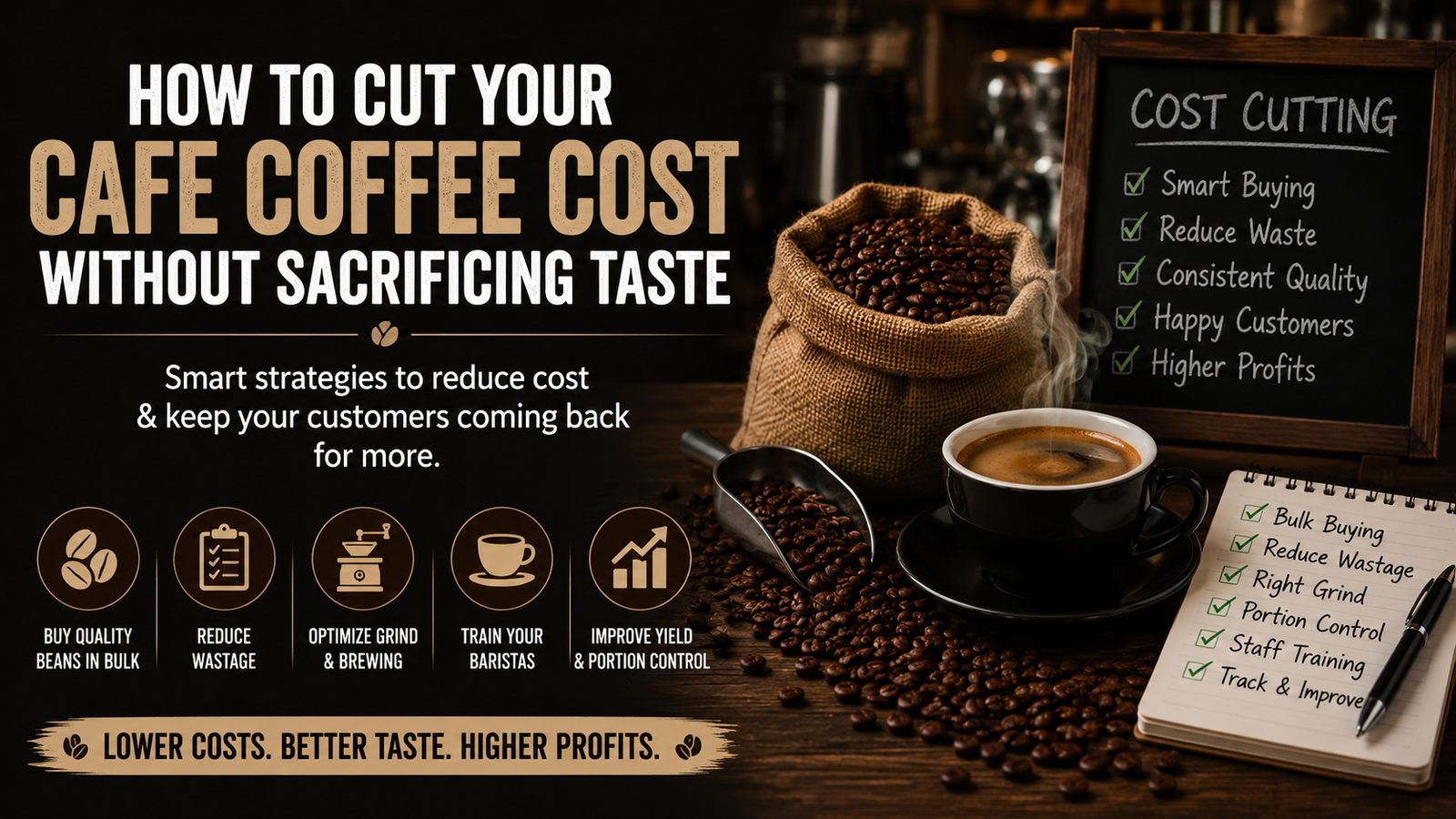
Putting It All Together: Your 30% Cost Reduction Roadmap
Implementing all of the strategies in this guide simultaneously is not necessary or practical. Start with the highest-impact changes first.
Week one, calculate your current true cost per cup. Measure your actual dose weight and compare it to the recommended 18 to 19 grams. The gap between what you are currently dosing and what you should be dosing is pure waste — and fixing it costs nothing.
Week two, review your ordering pattern. Are you buying in quantities you can use within 20 to 25 days of roasting? If not, adjust your order frequency.
Week three, audit your storage. Are beans stored in airtight, opaque containers away from heat? Fix any gaps immediately.
Month two, evaluate your blend ratio and consider whether a quality Arabica-Robusta blend delivers better value than your current product.
Month three, negotiate with your supplier based on your documented monthly volume.
Applied consistently, these steps will reduce your effective coffee cost per cup by 20 to 30 percent without your customers tasting any reduction in quality. In most cases, they will notice an improvement.
Conclusion
Cutting cafe coffee costs is not about finding the cheapest beans. It is about eliminating the waste, inefficiency, and misalignment that quietly inflate your cost per cup without adding anything to the quality of what you serve.
Dose discipline, fresh ordering cycles, proper storage, the right blend ratio, and smart supplier relationships — these are the tools that reduce coffee cost sustainably while protecting or improving the cup quality that keeps your customers coming back.
Neelkanth Enterprise supplies coffee beans, blends, green coffee beans, and premix products to cafes and restaurants across Surat and Gujarat. We work with each customer to find the right product at the right cost for their specific operation. Contact us today to discuss your requirements or request a sample.