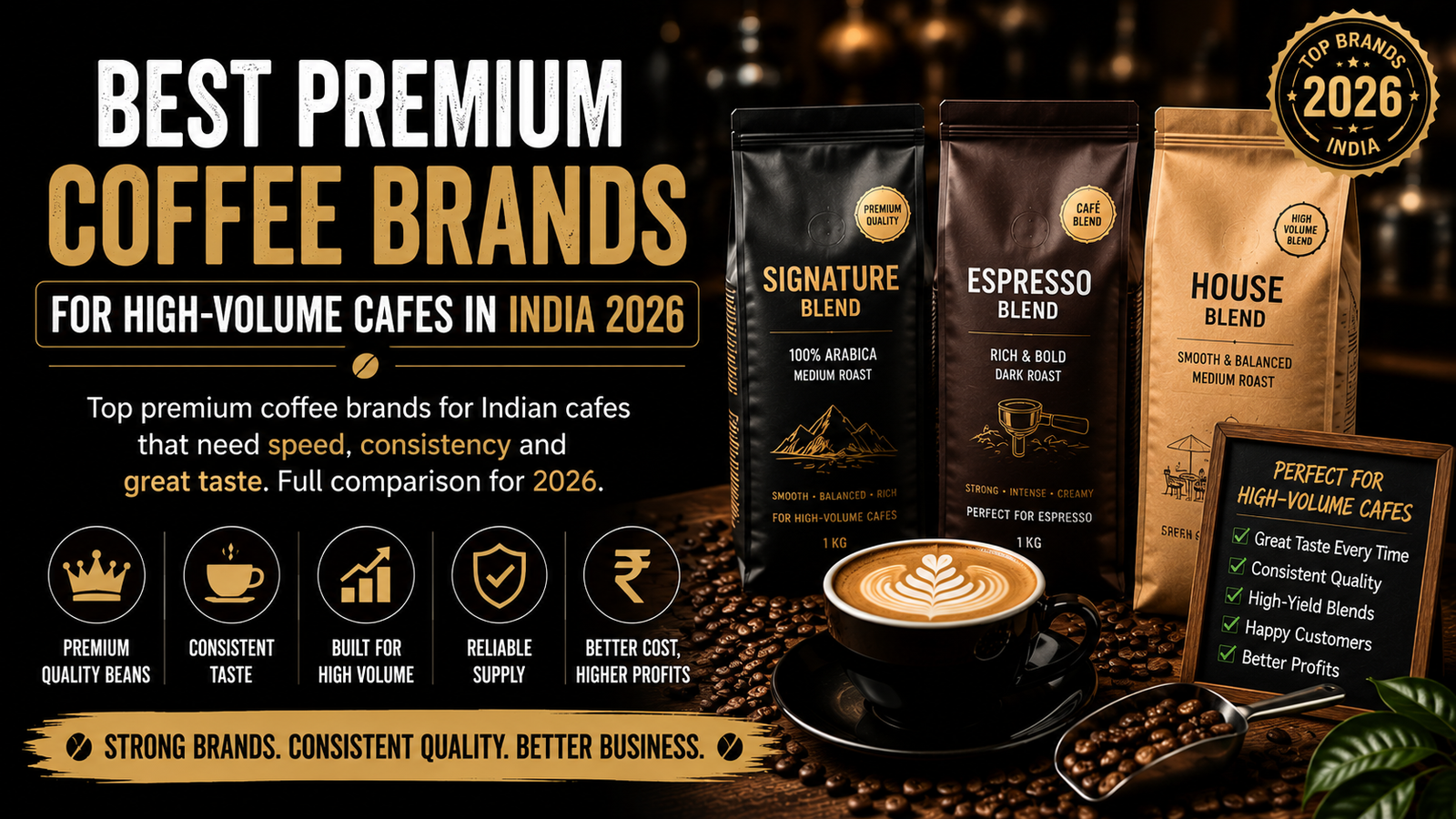

If you run a cafe or restaurant in India, the single most important ingredient decision you make every day is your coffee beans. The beans you choose define the aroma that draws customers in, the flavour that keeps them coming back, and the consistency that builds your reputation. Yet many cafe owners still buy beans without a clear strategy — picking whatever is cheapest or most familiar.
This guide is written specifically for cafe owners, restaurant managers, and commercial kitchen operators in India who want to make smarter, more profitable decisions about coffee beans in 2026.
Why Choosing the Right Coffee Beans Matters for Your Cafe
Coffee is no longer just a morning beverage in India. Urban customers today expect single-origin espresso, cold brews, filter coffee, and specialty lattes. The Indian specialty coffee market has grown over 35% in the last three years, and cities like Surat, Ahmedabad, Mumbai, and Bangalore now have customers who can genuinely taste the difference between a mediocre bean and a premium one.
The beans you source affect:
- Flavour consistency across every cup
- Compatibility with your coffee machine (important for commercial auto machines)
- Your cost per cup and profit margins
- Customer retention and word-of-mouth reviews
Getting this decision right is one of the highest-ROI actions you can take as a cafe owner.
Understanding Coffee Bean Types Available in India
Arabica Coffee Beans
Arabica is the most widely consumed coffee bean variety in the world, accounting for roughly 60% of global production. In India, Arabica is primarily grown in Karnataka (Coorg, Chikmagalur), Kerala, and Tamil Nadu.
Flavour profile: Smooth, slightly sweet, with notes of fruit, chocolate, or floral tones depending on origin. Low bitterness, medium body.
Best for: Espresso-based drinks, pour-overs, specialty lattes, cold brew.
Price range (2026): ₹600 – ₹2,500 per kg depending on grade and origin.
Arabica beans are ideal if your cafe targets specialty coffee drinkers or if you want to stand out with a refined menu. They work exceptionally well with modern automatic coffee machines that can extract at precise temperatures.
Robusta Coffee Beans
Robusta is India’s other major commercial coffee variety, grown heavily in Kerala and Karnataka. India is one of the world’s top Robusta exporters.
Flavour profile: Bold, strong, bitter, with earthy and woody notes. Higher caffeine content than Arabica.
Best for: Strong filter coffee, South Indian coffee blends, espresso blends that need body and crema.
Price range (2026): ₹250 – ₹700 per kg.
Robusta is the workhorse of commercial kitchens. It is more affordable, more disease-resistant, and produces that thick crema that many Indian coffee drinkers love. If your cafe serves a high volume of milk-based drinks — cappuccinos, lattes, and cold coffees — a Robusta-forward blend can significantly reduce your cost per cup without sacrificing perceived quality.
Arabica-Robusta Blends
Most cafes and restaurants in India actually use a blend rather than a single variety. A typical commercial blend is 60–70% Arabica for flavour and 30–40% Robusta for body and crema.
Best for: High-volume cafes serving espresso, cappuccino, latte, and filter coffee.
Blends give you the best of both worlds — the smoothness and complexity of Arabica with the affordability and crema of Robusta.
Green Coffee Beans
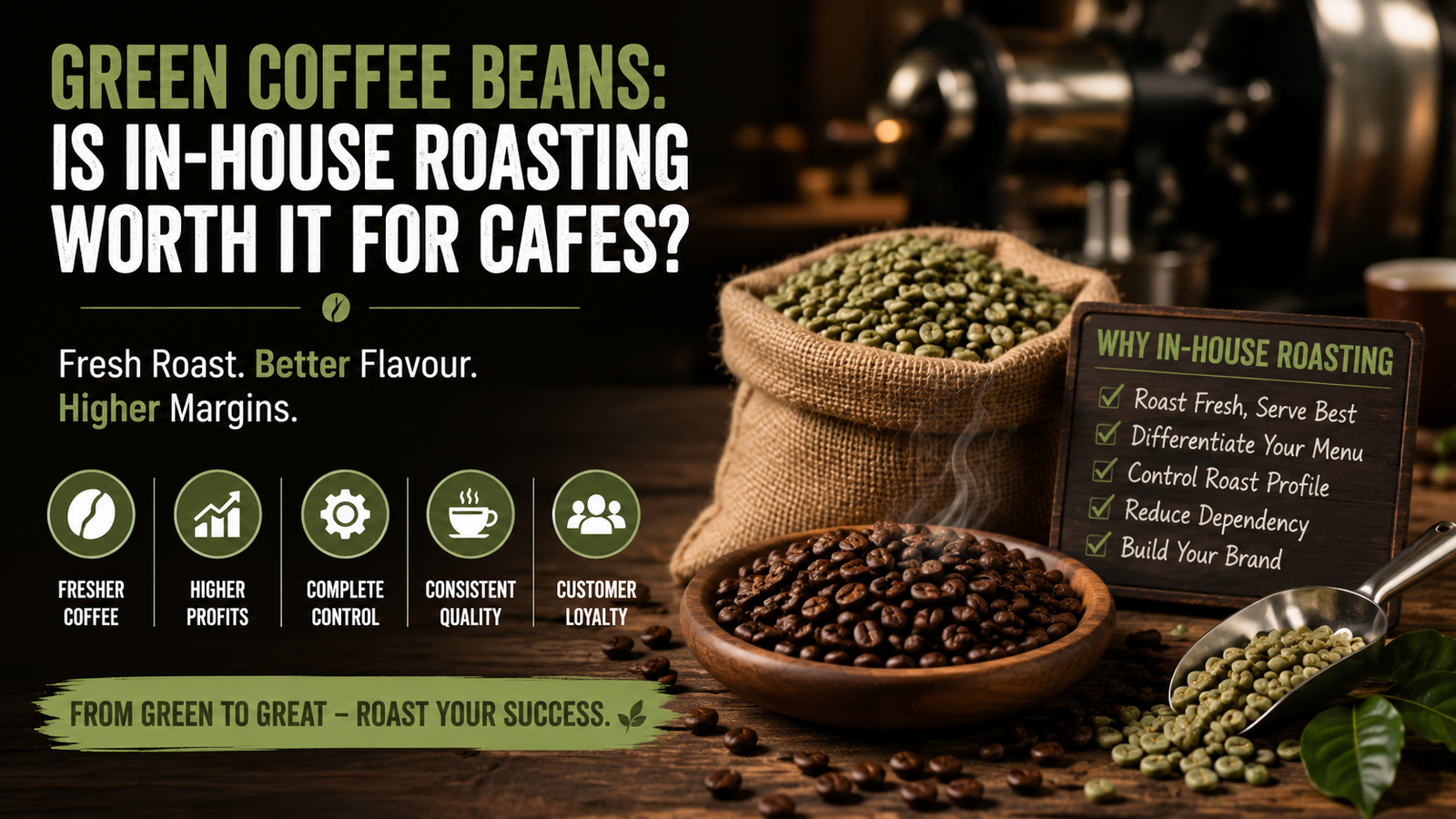
Green coffee beans are unroasted raw beans, popular among artisan roasters and some health-focused cafes. They can be roasted in-house to exact specifications.
Best for: Specialty roasters, cafes that want complete control over roast profiles.
Note: Green beans require a dedicated roasting setup. For most cafes, pre-roasted beans from a trusted supplier are more practical.
Top Indian Coffee Growing Regions to Know
Understanding origin helps you make better sourcing decisions and gives you talking points for your menu.
Coorg (Kodagu), Karnataka
Coorg produces some of India’s finest Arabica, grown at elevations of 900–1,500 metres under shade trees. Coorg Arabica is known for its balanced acidity, medium body, and clean finish. It is a premium choice for specialty cafes.
Chikmagalur, Karnataka
Often called the birthplace of Indian coffee, Chikmagalur grows both Arabica and Robusta. Its beans have a distinctive chocolatey, slightly fruity profile with good body — popular with commercial cafe blenders.
Wayanad, Kerala
Wayanad produces both Arabica and Robusta with consistent quality. It is one of India’s largest coffee-producing districts and a major source for commercial-grade beans. The beans here tend to be bold and earthy, well-suited for South Indian filter coffee.
Araku Valley, Andhra Pradesh
Araku has gained international recognition as a single-origin specialty destination. Tribal farmers grow organic Arabica at high altitudes, producing beans with complex floral and fruit notes. Araku coffee has won awards in Paris and commands premium pricing — excellent for specialty menus.
Nilgiris, Tamil Nadu
Nilgiri coffee is grown in the Blue Mountains at high elevation, giving it a bold flavour with bright acidity. It is popular in South Indian blends and is a solid choice for cafes serving traditional filter coffee.
How to Choose Coffee Beans for Your Cafe: A Step-by-Step Framework
Step 1: Know Your Drink Menu
Your menu drives your bean decision. If you serve mostly espresso-based drinks — cappuccinos, lattes, flat whites — you need a medium-dark roast blend with good crema. If you serve specialty filter coffee or pour-overs, a lighter Arabica works better. If you serve South Indian filter coffee, a Robusta-dominant blend is non-negotiable.
Step 2: Match Beans to Your Coffee Machine
This is a point many cafe owners overlook. Different coffee machines require different grind sizes and extraction pressures. Commercial automatic espresso machines are optimised for medium-to-dark espresso roasts. Using a very light roast in a machine calibrated for medium-dark can result in under-extraction, weak flavour, and unhappy customers.
If you use a Neelkanth Enterprise coffee machine, consult with your equipment supplier about the ideal bean and roast profile for your specific model. Getting this pairing right makes a measurable difference in cup quality.
Step 3: Decide Between Whole Bean and Pre-Ground
Whole beans stay fresh significantly longer than pre-ground coffee. If your machine has an integrated grinder, always buy whole beans. Pre-ground coffee loses 50% of its volatile aromatic compounds within 15 minutes of grinding — buying pre-ground is a shortcut that costs you cup quality.
Step 4: Assess Freshness and Roast Date
Always check the roast date on your coffee bags — not just the expiry date. Ideally, espresso beans should be used between 7 and 21 days after roasting. Beans older than 30 days lose their degassing CO₂, which is what creates crema in espresso.
Step 5: Calculate Your True Cost Per Cup
Price per kilo is not the same as cost per cup. A premium Arabica at ₹1,500/kg might produce 140 cups per kg, costing you ₹10.7 per cup. A cheaper blend at ₹600/kg that produces only 100 cups per kg costs ₹6 per cup — but if it drives away customers, it costs you far more in lost revenue. Always calculate cost-per-cup, not cost-per-kilo.
Roast Levels Explained: Light, Medium, and Dark
| Roast Level | Flavour | Best Use |
|---|---|---|
| Light Roast | Bright, fruity, acidic | Filter coffee, pour-over, specialty |
| Medium Roast | Balanced, chocolatey | Espresso, cappuccino, latte |
| Medium-Dark | Rich, bold, low acidity | Espresso blends, cold brew |
| Dark Roast | Strong, smoky, bitter | South Indian filter, traditional espresso |
For most commercial cafes in India, a medium-dark roast Arabica-Robusta blend delivers the best balance of flavour, consistency, and customer satisfaction.
Premix Coffees vs Whole Bean: What’s Right for You?
Many high-volume restaurants and corporate cafes in India use coffee premixes rather than whole beans. Premix coffees are pre-blended instant or soluble coffee powders that work with vending machines and automatic dispensers.
Premix is ideal when:
- You need consistency across multiple staff who don’t have barista training
- You operate a high-volume canteen or corporate cafeteria
- Speed of service is more important than specialty flavour
Whole bean is ideal when:
- You have trained baristas
- Your brand is built around coffee quality
- You serve specialty or artisan drinks
Neelkanth Enterprise supplies both whole bean coffee and premix options to businesses across Surat and Gujarat — making it easy to choose the right format for your operation.
Where to Buy Coffee Beans for Your Cafe in India (2026)
When sourcing beans, look for these qualities in a supplier:
- Consistent quality and supply availability
- Transparent origin and roast date information
- Ability to supply both small and large volumes
- Knowledge of which beans pair well with which machines
- After-sales support, especially if you also purchased equipment from them
In Surat and across Gujarat, Neelkanth Enterprise has been supplying premium teas, coffee beans, green coffee beans, and coffee premix powders to restaurants and cafes since 2016. Working with a local supplier means faster restocking, personalised service, and the ability to sample before you commit.
Final Checklist Before You Order Coffee Beans
- Know your machine’s requirements (ask your equipment supplier)
- Choose the right variety for your drink menu
- Always check roast date — not just expiry date
- Buy whole bean if your machine has a grinder
- Calculate cost-per-cup, not just cost-per-kilo
- Order a trial quantity before committing to bulk
Conclusion
Choosing the best coffee beans for your cafe in India is not about buying the most expensive option — it is about matching the right bean to your menu, your machine, and your customers. Whether you run a high-volume restaurant in Surat or a specialty coffee shop in Ahmedabad, investing time in your bean selection is one of the most impactful decisions you can make in 2026.
Neelkanth Enterprise offers a curated range of coffee beans, green coffee beans, and premix powders for commercial kitchens across Gujarat. Contact us today to discuss your requirements or visit our products page to explore our range.