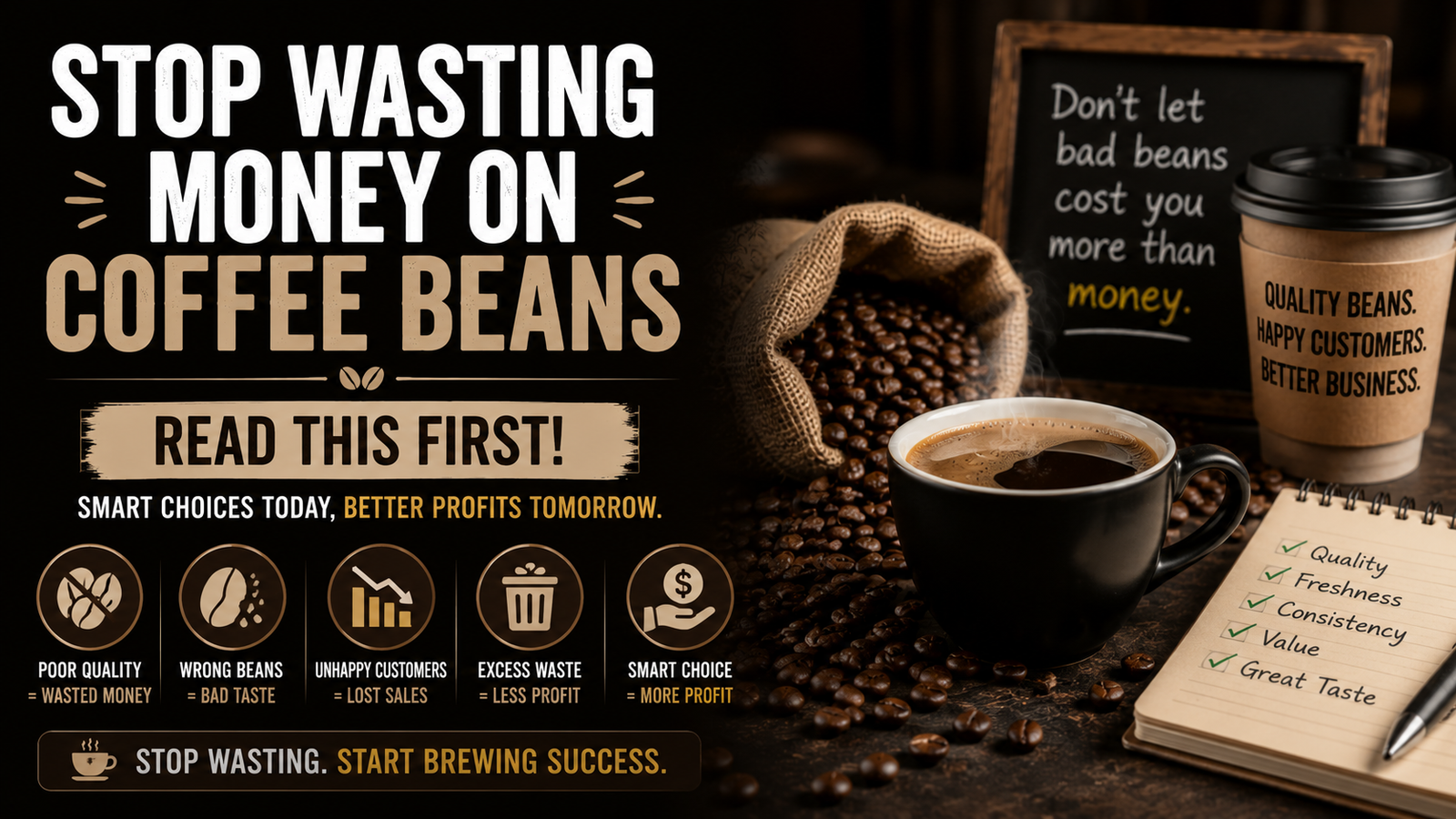
Every month, thousands of cafe owners across India overpay for coffee beans and get nothing extra in return. Not better flavour. Not more consistent cups. Not happier customers. Just higher costs that quietly eat into their margins while the coffee in the cup remains mediocre.
If you run a cafe or restaurant in Surat, Ahmedabad, or anywhere in India, this guide will change how you think about coffee bean purchasing. You will learn exactly where the money is being wasted, how to calculate your real cost per cup, and how to source smarter without sacrificing the quality your customers expect.
The Expensive Mistake Most Cafe Owners Make
The single most common money mistake in cafe coffee purchasing is confusing cost per kilogram with cost per cup.
A bag of premium coffee beans at ₹1,200 per kg sounds expensive. A bag of commercial-grade beans at ₹450 per kg sounds like a bargain. But cost per kilogram is almost meaningless as a purchasing metric — what matters is how many good cups you extract from each kilogram, and whether those cups keep customers coming back.
Here is the real math. A quality Arabica-Robusta blend at ₹1,200 per kg, dosed correctly at 18 to 20 grams per double shot, produces approximately 50 to 55 double shots per kilogram — roughly ₹22 to ₹24 per shot. A low-grade blend at ₹450 per kg, requiring heavier dosing to compensate for weak flavour, might produce only 45 shots per kilogram — roughly ₹10 per shot. The cost difference per cup is ₹12 to ₹14. If that upgrade brings even 15 extra repeat customers per week at ₹180 average spend, the weekly revenue gain of ₹2,700 far exceeds the weekly bean cost increase of ₹400 to ₹600.
This is the calculation most cafe owners never do. And not doing it is costing them far more than the price of better beans.
Where Cafe Owners Are Wasting Money on Coffee Beans
Buying More Than You Can Use Fresh
Coffee beans have a peak flavour window. For espresso, that window is 7 to 25 days after roasting. After 30 days, the volatile oils and CO2 that create aroma and crema begin to degrade significantly. After 45 to 60 days, you are brewing with beans that have lost much of their character.
Many cafe owners buy coffee beans in large quantities to get a bulk discount. The logic seems sound — pay less per kilogram by buying more. But if those beans sit in storage past their peak window, you are not getting a discount. You are paying for beans and then throwing away their best quality.
Buying 10 kg at ₹400 per kg looks like a saving over buying 2 kg at ₹450 per kg. But if 6 kg of that bulk purchase goes stale before you use it, the effective cost of the fresh coffee you actually served is far higher than the sticker price suggested.
The fix is simple: order more frequently in smaller quantities. Work with a local supplier who can turn around fresh stock quickly. In Surat and across Gujarat, sourcing locally from Neelkanth Enterprise means you get fresh-roasted beans faster and more reliably than ordering from distant online suppliers with slow shipping times.
Paying for Packaging and Branding, Not Quality
Some of the most expensive coffee beans available in India are expensive primarily because of their packaging, their marketing, and their brand positioning — not because the beans inside are genuinely better.
Specialty coffee branding is a powerful sales tool. Terms like single-origin, micro-lot, natural process, and third wave are legitimate descriptors of real quality differences — but they are also frequently used as premium pricing levers on products that deliver no meaningful improvement in a high-volume commercial cafe context.
A specialty light-roast Ethiopian single-origin bean designed for slow pour-over brewing in a specialty cafe does not belong in a commercial automatic espresso machine serving 200 cappuccinos a day. The extraction profile is wrong, the flavour is inappropriate for milk-based drinks, and you are paying a significant premium for a product that performs worse in your context than a well-sourced commercial blend would.
Know what your machine is designed for and what your drink menu requires. Then buy the best possible bean for that specific purpose — not the most impressively labelled one.
Not Accounting for Waste From Poor Storage
Improper storage is one of the most invisible and consistent sources of wasted coffee spend in Indian cafes. Heat, light, air, and moisture all accelerate the staling of roasted coffee beans dramatically.
Beans stored in open bags on the counter, in glass jars near the espresso machine, or in a storage area that gets warm during the day can lose a significant portion of their flavour quality within 3 to 5 days of opening the bag. You are effectively paying for beans and then watching their value evaporate through a jar lid.
A quality airtight, opaque coffee storage container costs ₹500 to ₹1,500. If it extends the usable quality window of your beans by even a week, it pays for itself in the first month through reduced waste and better cup quality.
Store whole beans in airtight, opaque containers at room temperature, away from the espresso machine and any heat source. Only transfer a 2 to 3 day supply to your counter-level container at a time. Keep the bulk supply sealed in a cool, dark cupboard.
Buying Pre-Ground Coffee
This one is straightforward. Pre-ground coffee begins staling the moment the grind happens. Within 15 minutes of grinding, the aromatic compounds start escaping. Within a few hours, a significant portion of the flavour character is gone.
If you are buying pre-ground coffee to save time or because your machine does not have an integrated grinder, you are paying for coffee quality you will never taste in the cup. Every gram of flavour that escapes between the grinder and the portafilter is money you paid for and threw away.
If your commercial espresso machine does not have an integrated grinder, the single best investment you can make for your cup quality and your cost efficiency is adding one. Grind to order, every time.
Working With a Supplier Who Cannot Tell You the Roast Date
If your current coffee supplier cannot or will not tell you the exact roast date of the beans they are selling you, you are flying blind on freshness. You may be paying full price for beans roasted 60 to 90 days ago that are well past their peak flavour window.
Roast date transparency is a basic standard among quality suppliers. If your supplier only provides a best-before date that is 12 to 18 months away, they are prioritising shelf life marketing over your cup quality.
Always ask directly: when were these beans roasted? Any reliable supplier will answer this question immediately and accurately.
How to Calculate Your Real Cost Per Cup
Stop thinking in rupees per kilogram. Start thinking in rupees per good cup served. Here is a simple framework:
Step 1 — Weigh your dose. How many grams of coffee do you use per double espresso shot? Most commercial setups use 18 to 21 grams.
Step 2 — Calculate shots per kilogram. At 18 grams per shot, one kilogram produces approximately 55 double shots. At 21 grams per shot, one kilogram produces approximately 47 shots.
Step 3 — Calculate bean cost per shot. Divide the price per kilogram by the number of shots. At ₹900 per kg and 55 shots per kg, your bean cost per double shot is approximately ₹16.
Step 4 — Factor in waste. If 10 percent of your beans go stale before use, your effective cost per usable shot rises accordingly. Reduce waste through better storage and ordering frequency.
Step 5 — Assess the revenue impact. A better bean that costs ₹8 more per shot but generates 20 percent more repeat business is not a cost — it is a highly profitable investment.
Most cafe owners who go through this calculation for the first time are surprised to find that upgrading their bean quality costs less than ₹5 to ₹8 per cup in additional bean spend, while the revenue impact of better customer retention is many times larger.
Smart Buying: What to Look for in a Coffee Bean Supplier
Fresh Stock, Local Supply
Local suppliers with fast turnaround give you fresher beans more consistently than any online supplier shipping from a distant city. Fresher beans mean better flavour, stronger crema, and more satisfied customers — without any increase in cost per kilogram.
Roast Date Transparency
A good supplier tells you exactly when the beans were roasted and ensures you are receiving stock within an appropriate freshness window for your usage volume.
The Right Product for Your Specific Operation
Not every bean is right for every cafe. A good supplier asks about your machine, your drink menu, your volume, and your customer base before recommending a product. They do not just sell you the most expensive item in their range.
Samples Before Commitment
Before committing to any new bean, request a sample. Brew it on your actual machine at your standard settings. Taste it black. Taste it in a cappuccino. Only commit once you are satisfied with the cup quality.
Consistent Quality Between Batches
Your regular customers will notice if the coffee tastes different from week to week. A reliable supplier maintains consistent roast profiles and supply quality across every batch they deliver.
The Smarter Way to Source Coffee Beans in India
Once you understand the real cost structure of coffee beans — freshness windows, cost per cup, storage losses, and the revenue impact of cup quality — the purchasing decision becomes much clearer.
Spending ₹200 to ₹400 more per kilogram on a quality, fresh-roasted blend that is correctly matched to your machine and drink menu is not extravagance. It is the most efficient use of your coffee budget, because it simultaneously reduces waste, improves cup quality, and increases the likelihood that every customer who sits down with your coffee will come back.
Neelkanth Enterprise supplies premium coffee beans, green coffee beans, and commercial premix options to cafes, restaurants, and hotels across Surat and Gujarat. We work directly with each customer to match the right product to their machine, their menu, and their volume — so you get maximum value from every kilogram you purchase.
Contact us today to request a sample, discuss your requirements, or explore our full coffee range.
Conclusion
The most expensive coffee beans are not always the best value. And the cheapest beans are almost never the real bargain they appear to be. The cafe owners who get coffee purchasing right are the ones who think in cost per good cup served, prioritise freshness over bulk savings, invest in proper storage, and work with suppliers who understand their operation.
Stop paying for coffee quality you never taste in the cup. Source smarter, brew fresher, and watch the difference it makes — in your cups, and in your repeat customer numbers.