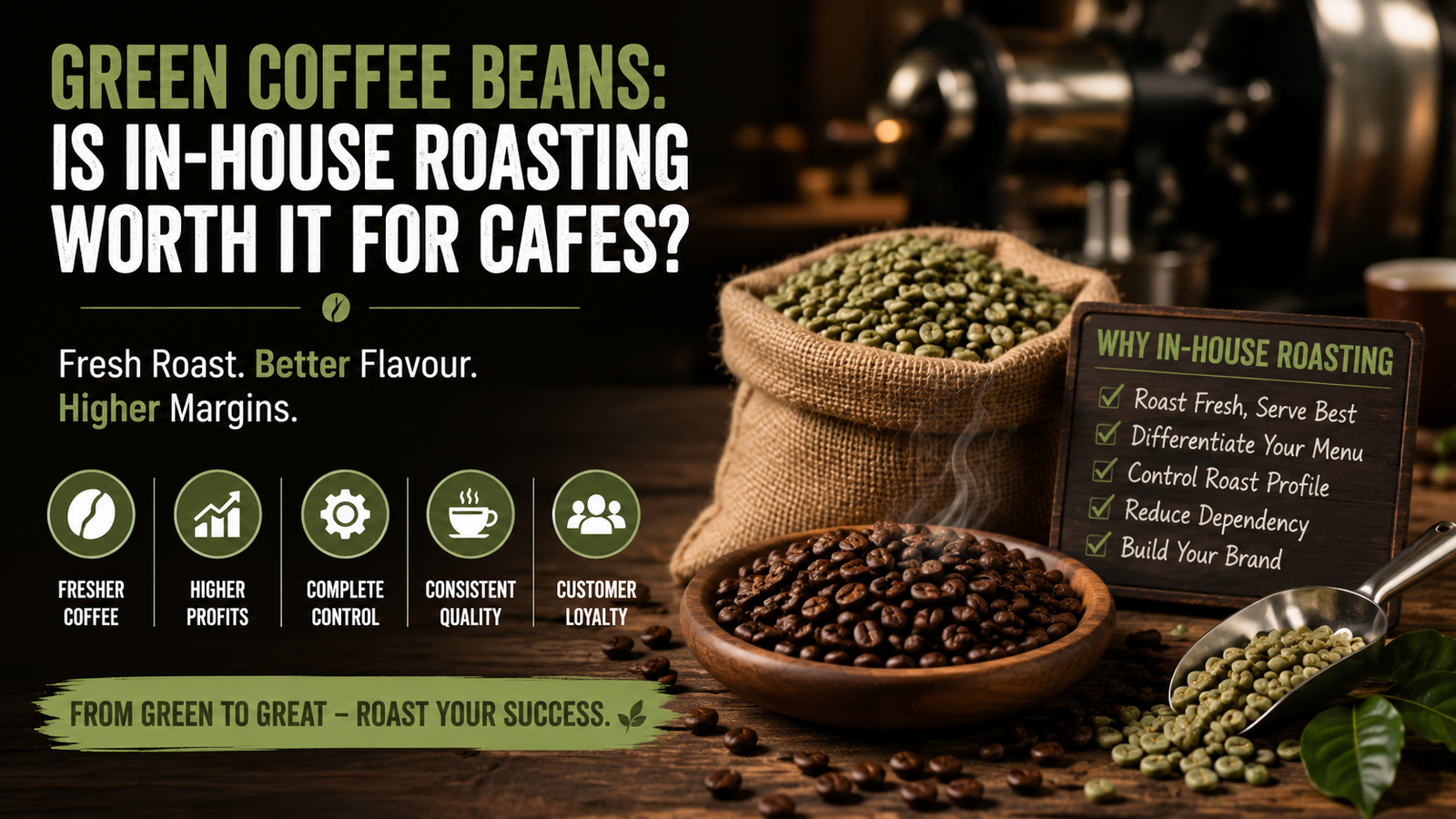
Walk into any progressive specialty cafe in India today and there is a reasonable chance you will see a roaster. It might be a small drum roaster tucked behind the counter, or a larger commercial unit visible through a glass wall. The message is deliberate: we roast our own beans, and that makes us different.
In-house roasting has become one of the most aspirational moves a cafe can make in 2025. It signals quality, authenticity, and total control over the supply chain. It looks impressive to customers. And on paper, the economics look compelling — green coffee beans cost a fraction of the price of pre-roasted beans.
But is in-house roasting actually worth it for your cafe? The honest answer depends entirely on your volume, your budget, your team, and your brand goals. This guide breaks down everything you need to know before making the decision — including the costs, the equipment, the skills required, and the hidden realities that most in-house roasting success stories leave out.
What Are Green Coffee Beans?
Green coffee beans are raw, unroasted coffee seeds. They are the same Arabica or Robusta beans that eventually become the roasted coffee you brew — but in their natural state, before the roasting process develops the sugars, oils, and aromatic compounds that give coffee its flavour, aroma, and colour.
In their green state, coffee beans are pale grey-green, dense, and smell faintly grassy or vegetal rather than like coffee. They contain no soluble flavour compounds that would produce a drinkable brew — roasting is the process that transforms them from raw agricultural product into what we recognise as coffee.
Green coffee beans are available from Indian suppliers, importers, and directly from estates and cooperatives. Because they have not yet been roasted, they are sold at raw commodity pricing rather than the premium commanded by roasted, packaged specialty coffee. This price gap is the primary commercial argument for in-house roasting.
Green beans also have significantly longer shelf life than roasted beans — stored correctly in cool, dry conditions, green beans remain viable for roasting for 12 to 18 months or more. This gives cafes with in-house roasting far more flexibility in purchasing timing and inventory management.
The Price Gap: How Big Is It Really?
Let us look at the actual numbers that make in-house roasting attractive.
Quality Indian Arabica green beans from Coorg or Chikmagalur origin are typically available at ₹350 to ₹700 per kg depending on grade, certification, and volume. The same beans, pre-roasted and packaged by a specialty roaster, typically retail at ₹900 to ₹2,000 per kg.
The raw price gap looks enormous — sometimes a 200 to 300 percent difference. But the meaningful comparison is not raw bean price versus roasted bean price. It is the total cost of in-house roasting versus the all-in cost of buying pre-roasted beans, including equipment amortisation, energy, time, and waste.
Green beans lose approximately 15 to 20 percent of their weight during roasting due to moisture evaporation. A kilogram of green beans becomes roughly 820 to 850 grams of roasted coffee. This weight loss must be factored into your cost per roasted kilogram calculation.
At ₹500 per kg for green beans and 17 percent roast loss, your raw material cost per kg of roasted coffee is approximately ₹600. Against a comparable pre-roasted product at ₹1,200 per kg, the raw material saving is ₹600 per roasted kilogram. That gap funds your roasting equipment over time — but how long it takes depends entirely on your roasting volume.
The Equipment Reality: What You Actually Need
This is where most in-house roasting conversations get honest very quickly. Roasting coffee at commercial quality requires real equipment investment.
Home or Sample Roasters (Under ₹30,000)
Small drum roasters and fluid bed roasters in the ₹10,000 to ₹30,000 range can roast 200 to 500 grams per batch. They are suitable for experimentation, developing roast profiles, and very small specialty menus where total coffee consumption is under 2 kg per week.
At this scale, in-house roasting is more of a brand statement than a cost-saving measure. The labour time per kilogram roasted is very high, and the roasting consistency is heavily dependent on operator attention and skill. These machines are genuinely useful for learning and for creating a unique customer experience, but they are not a commercial solution for most cafes.
Mid-Range Commercial Roasters (₹1.5 to ₹4 Lakh)
A mid-range drum roaster capable of roasting 1 to 3 kg per batch, with basic profile logging, is the entry point for serious commercial in-house roasting. At this capacity, a cafe consuming 10 to 20 kg of coffee per week can realistically handle its own supply with 8 to 12 roasting sessions per week.
These machines require dedicated space, adequate ventilation, and a trained operator. They produce meaningful cost savings at sufficient volume, but the payback period on the equipment investment at a typical Indian cafe scale is 18 to 36 months before savings materialise.
Professional Commercial Roasters (₹5 Lakh and Above)
At this level, you are investing in a roaster capable of 5 to 15 kg batches with precise profile control, data logging, and consistent repeatability. This is the equipment standard for cafes that roast for retail sale, wholesale supply to other businesses, or very high in-house consumption.
The economics at this scale are compelling — but so is the commitment. A professional roaster requires significant floor space, industrial ventilation, fire safety provisions, and an experienced full-time or near-full-time roaster operator.
Supporting Equipment Often Overlooked
Beyond the roaster itself, in-house roasting requires a precision grinder calibrated to your roast profiles, a cooling tray or separate cooling system if the roaster does not include one, sealed storage containers for green bean inventory, roasted bean storage containers with degassing valves, and ideally a cupping setup for quality control. This supporting equipment adds ₹50,000 to ₹2,00,000 to your initial investment depending on quality level.
The Skill Requirement: Roasting Is Not Simple
This is the part that is most consistently underestimated by cafe owners considering in-house roasting for the first time. Roasting coffee to a consistent, high-quality standard is a skilled craft that takes months to learn and years to master.
During roasting, green beans undergo a complex sequence of chemical transformations — moisture evaporation, Maillard reactions, caramelisation, first crack, second crack — that determine the final flavour profile of the coffee. The roaster operator must monitor temperature curves, time profiles, and sensory cues simultaneously, making real-time adjustments to hit a target flavour outcome.
Early in the learning process, batches are frequently inconsistent. Beans can be under-developed — green tasting, grassy, thin — or overdeveloped — harsh, ashy, bitter. The learning curve involves real product waste and real quality variation that customers may notice.
Professional roasters train for 6 to 18 months under experienced mentors before roasting independently for commercial production. Most specialty roasters in India consider 2 to 3 years of regular practice the minimum to roast truly consistently across different origins and roast profiles.
If you plan to roast in-house, factor in a meaningful training period, the cost of wasted green beans during that period, and either your own time or the salary of a dedicated roaster operator.
The Hidden Time Cost
Roasting coffee takes time — not just the active roasting session, but the full workflow around it. Weighing and preparing green bean batches, roasting, cooling, resting the freshly roasted beans for the degassing period (typically 24 to 48 hours minimum before use), quality cupping and tasting, adjusting profiles, cleaning the roaster, and managing green bean inventory all add up.
For a cafe owner already managing staff, service, suppliers, and customers, adding roasting operations to the daily workflow is a significant commitment. If you plan to roast yourself rather than hire a dedicated roaster, be realistic about how much time this will consume relative to everything else your business needs from you.
For cafes where the owner is also the head barista and general manager, in-house roasting often creates operational pressure that eventually forces a choice between roasting quality and cafe quality. The cafes that do in-house roasting successfully over the long term almost always have a dedicated roaster role — someone whose primary job is managing the roasting operation.
Who Should Consider In-House Roasting
Despite all of the above, in-house roasting is genuinely the right decision for some cafes. Here is the profile of an operation for which it makes sense.
Your cafe consumes at least 15 to 25 kg of roasted coffee per week, giving you sufficient volume to justify the equipment investment and generate meaningful cost savings within a reasonable payback period.
Your brand identity is built around coffee craft and quality. In-house roasting becomes a genuine differentiator and a customer experience feature — the smell, the theatre, the transparency of seeing your own roaster at work all contribute to a compelling brand story.
You have the capital or financing for the equipment upfront and can absorb the learning curve period without it damaging your cafe’s reputation.
You have or can hire someone with genuine roasting training and experience, or you are personally committed to developing that skill seriously over 12 to 18 months.
You want to expand into retail bean sales or wholesale supply to other cafes, making roasting capacity a revenue-generating asset rather than purely a cost centre.
Who Should Stick With Pre-Roasted Beans
For most cafes in India, particularly at small to medium scale, sourcing pre-roasted beans from a quality, fresh-focused supplier is the right decision — not a compromise, but a genuinely better strategy.
If your weekly coffee consumption is under 10 kg, the economics of in-house roasting are difficult to justify. The equipment cost amortised over realistic volumes, combined with the time investment and the learning curve, produce a cost per cup that is often higher than simply buying fresh-roasted beans from a good supplier.
If your team does not include anyone with roasting experience, the quality risk during the learning period is real and can damage the customer experience you have worked hard to build.
If your brand is built on service, atmosphere, food, or a specific beverage program rather than specifically on coffee craft, the resources invested in roasting infrastructure would likely generate better returns invested elsewhere in the business.
And if your current pre-roasted bean supplier provides genuinely fresh stock — beans within 7 to 14 days of roasting — the quality gap between in-house and supplier-roasted beans is often smaller than expected, particularly for milk-based drink menus where extraction subtleties matter less than in black coffee preparations.
Green Coffee Beans as a Supplier Product
One final consideration: even if you are not ready to roast in-house, green coffee beans from a supplier like Neelkanth Enterprise can play a role in your operation. Some cafes source green beans for experimentation, staff training, or small-batch specialty roasting for a specific menu item — a seasonal single-origin offering, a featured cold brew batch, or a retail product — without committing to full in-house production.
This hybrid approach lets you explore the world of green beans and roasting without the full operational commitment, building knowledge and capability over time while your primary supply chain remains stable and reliable.
Neelkanth Enterprise supplies green coffee beans alongside pre-roasted blends and commercial premix products to cafes across Surat and Gujarat. Contact us to discuss green bean availability, pricing, and what origins are currently in stock.
Conclusion: The Honest Verdict
In-house roasting with green coffee beans is worth it for cafes with high volume, a roasting-centred brand, the right equipment budget, and genuine roasting skill or the commitment to develop it. For these cafes, the economics are real and the brand differentiation is powerful.
For the majority of small to mid-size cafes in India, sourcing fresh-roasted beans from a quality local supplier delivers better cup consistency, lower operational complexity, and more predictable costs than in-house roasting at current scale.
The decision is not about which approach is objectively better — it is about which approach is right for your specific operation, your volume, your team, and your brand goals. Make it with clear eyes and honest numbers, not because the idea of roasting your own beans sounds exciting.