India’s pizza market has grown at a remarkable pace. From international QSR chains in metropolitan malls to independent pizza restaurants in tier-two cities like Surat, Rajkot, and Vadodara, pizza has become one of the most reliably profitable items on the Indian restaurant menu. Customers love it. It travels well for delivery. It scales easily from a four-person family order to a corporate catering request.
But behind every successful pizza operation is a piece of equipment that most customers never think about and most new restaurant owners underestimate: the oven. Specifically, whether you are using the right type of oven for the volume and consistency your business demands.
If you run a pizza restaurant in India and you are not using a conveyor gas pizza oven, this guide explains exactly why you should be — and what the difference looks like in your daily operations, your product quality, and your bottom line.
The Oven Problem Most Pizza Restaurants Have
Walk into most independent pizza restaurants in India and you will find one of two things behind the counter: a deck oven or an impingement conveyor oven. The deck oven is the traditional choice — a baking chamber with a stone or steel deck that radiates heat from below while a heating element above cooks the top. It produces excellent pizza when operated correctly by an experienced pizzaiolo.
The problem is the word experienced. Deck ovens require skill to operate well. The operator must judge when to rotate the pizza, monitor the colour of the crust, manage temperature fluctuations across zones, and pull each pizza at exactly the right moment. In a low-volume artisan pizzeria with one skilled baker, this is manageable. In a restaurant doing 60 to 200 pizzas per service with multiple SKUs and mixed staff experience levels, it is a daily source of inconsistency and stress.
Inconsistent pizza is one of the primary complaints in Indian pizza restaurant reviews. A customer who received a perfectly charred, crispy-based pizza on their first visit and a pale, undercooked one on their second visit does not return for a third. The inconsistency problem is almost always an oven-and-operator problem, not a recipe problem.
Conveyor ovens solve this entirely.
What Is a Conveyor Gas Pizza Oven?
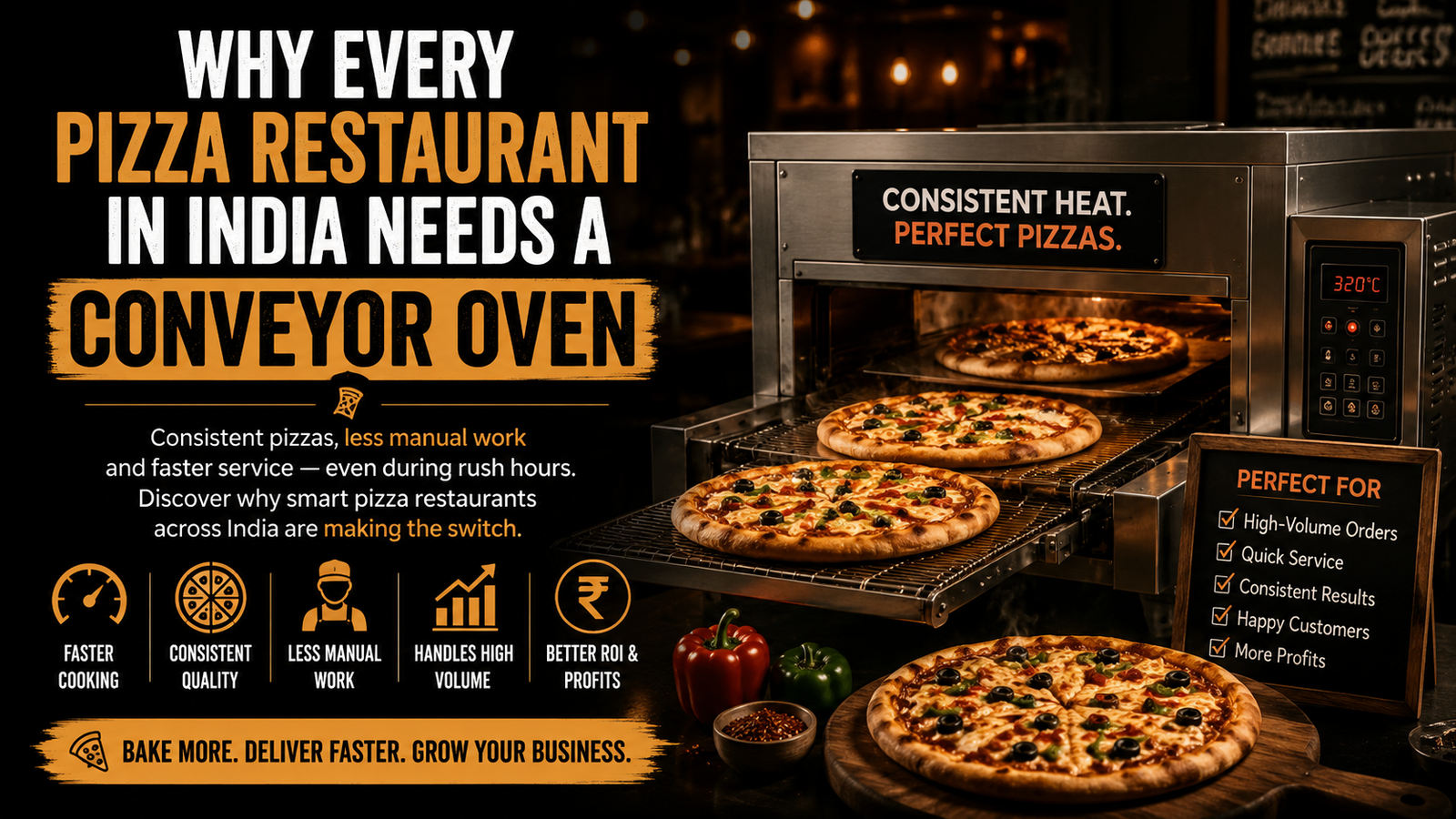
A conveyor gas pizza oven — also called an impingement conveyor oven — moves pizza through a heated chamber on a continuous belt at a precisely controlled speed. Hot air jets impinge on the pizza from above and below as it travels through the chamber. By the time the pizza exits the other end of the belt, it is cooked to exactly the same standard as every other pizza that has passed through those same settings.
The key difference from every other oven type is this: the output of a conveyor oven is determined by the machine settings, not by the operator’s skill or attention. Once the temperature and belt speed are calibrated correctly for your pizza specification, every pizza is cooked identically — regardless of which staff member loads it, what time of day it is, or how busy service is.
This is not a small operational advantage. It is transformational for restaurant businesses at any scale beyond the artisan single-pizzaiolo operation.
Benefit 1: Unmatched Cooking Consistency
This is the defining advantage of a conveyor oven and the reason it has become the standard equipment choice for every major pizza chain in the world.
When a customer orders a Margherita from your restaurant, they have a specific expectation based on previous visits. The crust should be a specific colour and texture. The cheese should be melted to a specific degree. The toppings should be cooked but not burnt. If these parameters change from visit to visit, the customer’s trust in your product erodes.
With a conveyor oven calibrated to your recipe, every Margherita that exits the oven looks and tastes the same. Whether it was loaded by your most experienced cook or a new hire on their second day. Whether it was ordered at 1pm or 9pm. Whether service is quiet or the restaurant is at capacity.
This consistency is what turns first-time customers into regulars and allows your restaurant to scale. You cannot build a reliable brand around a product whose quality depends on who is working that day.
Benefit 2: Significantly Higher Output Per Hour
Speed matters enormously in the pizza restaurant business, particularly as delivery platforms like Swiggy and Zomato have made order volume and delivery time central to customer ratings and restaurant visibility.
A commercial conveyor gas pizza oven with a 14 to 18 inch belt width can produce 40 to 80 pizzas per hour depending on belt speed and pizza size. At peak settings, high-capacity conveyor ovens with 24 inch belts can exceed 100 pizzas per hour. These numbers are consistent and predictable — the output does not drop because the operator is tired or because two orders came in simultaneously.
Compare this to a deck oven, where a single experienced operator managing one deck typically produces 15 to 25 pizzas per hour with attentive monitoring. During peak service, when attention is divided, this number drops and quality suffers.
For a restaurant processing 150 to 300 delivery and dine-in orders across a lunch and dinner service, the output capacity of a conveyor oven is not a luxury — it is a business necessity.
Benefit 3: No Specialised Operator Skill Required
One of the most underappreciated benefits of conveyor oven technology in the Indian restaurant context is the skill independence it provides.
India’s restaurant industry faces significant staff turnover challenges. Training a skilled deck oven operator takes weeks to months. Every time that person leaves, the training investment walks out with them and pizza quality immediately suffers until a replacement is trained to the same standard.
A conveyor oven requires no specialised skill to operate. The staff member loads the pizza onto the belt. The machine does the rest. New hires are operational on the oven within hours, not weeks. Staff turnover at the oven station stops being a business risk.
This has a direct impact on labour planning and training costs. It also means that your restaurant’s pizza quality is no longer a function of who you happen to have working that shift — it is a function of how well your conveyor oven is set up and maintained.
Benefit 4: Even Heat Distribution for Better Pizza
The impingement technology in a conveyor oven directs jets of precisely heated air at the pizza surface from above and below simultaneously. This produces a fundamentally different cooking dynamic from a deck oven, where heat radiates upward from the stone and may be uneven across the deck surface.
Impingement cooking cooks the base and the top of the pizza simultaneously and uniformly across the entire surface. The crust cooks evenly from edge to edge. The cheese melts uniformly without the spots of under-melted or over-browned cheese that are common with radiant heat ovens. Toppings cook consistently across the entire pizza surface.
For pizza styles with heavy toppings — popular in the Indian market where loaded vegetarian and paneer-based pizzas are high sellers — even heat distribution is particularly important. Heavy toppings absorb and redistribute heat unevenly in a radiant oven, producing inconsistent results that are much harder to manage. Impingement cooking handles loaded toppings cleanly and consistently.
Benefit 5: Lower Gas Consumption Per Pizza Cooked
Gas is one of the most significant operating costs in any Indian restaurant kitchen, and it is a cost that compounds directly with output volume. The more pizzas you cook, the more gas you consume — unless your oven is efficient.
Conveyor gas pizza ovens are engineered for efficiency. The enclosed cooking chamber retains heat effectively. The impingement air jet system transfers heat directly and rapidly to the food rather than heating the ambient air around it. And because the cooking time per pizza is shorter than in a deck oven — typically 4 to 7 minutes in a properly calibrated conveyor oven versus 8 to 14 minutes in a deck oven — the gas consumption per pizza cooked is lower.
When you calculate gas cost per 100 pizzas cooked on a conveyor oven versus a deck oven over a full month, the saving is meaningful — particularly at the fuel prices Indian restaurants are managing in 2025. Over a year, the gas efficiency of a conveyor oven contributes significantly to its total cost of ownership calculation.
Benefit 6: Reduced Labour Costs at the Oven Station
In a deck oven operation, the oven station requires a dedicated, attentive operator throughout every service. This person cannot multitask effectively — their attention must remain on the oven, monitoring each pizza individually and reacting to differences in cooking speed.
In a conveyor oven operation, the oven station requires someone to load pizzas onto the belt and collect them at the exit. This is a straightforward, low-skill task that does not require dedicated attention — the same team member can simultaneously manage order preparation or other tasks during the cooking cycle.
Across a full service, this reduced attention requirement at the oven station translates to real labour efficiency. Many restaurant operators find that conveyor oven implementation allows them to reduce the headcount at the pizza station or redeploy those team members to higher-value tasks elsewhere in the kitchen.
Benefit 7: Easier Quality Control and Menu Standardisation
If you operate multiple restaurant locations, plan to franchise your concept, or simply want to standardise your menu quality across different shifts and different team members, a conveyor oven is the enabling technology that makes standardisation possible.
Conveyor oven settings — belt speed, temperature, top and bottom heat ratios — can be documented precisely for every pizza SKU on your menu. A Margherita has one setting. A loaded vegetarian pizza has another. A thin-crust has a third. These settings are documented, transferable, and reproducible across any conveyor oven of the same model.
This means your recipes are embedded in the equipment settings, not in the knowledge of individual staff. Your pizza tastes the same at your Surat location and your Ahmedabad location because both kitchens are running the same oven at the same settings with the same recipe documentation.
Conveyor Oven vs Deck Oven: Direct Comparison
| Feature | Conveyor Gas Oven | Deck Oven |
|---|---|---|
| Consistency | Identical every time | Operator-dependent |
| Output per hour | 40–100+ pizzas | 15–25 pizzas |
| Operator skill needed | Minimal | Significant |
| Training time | Hours | Weeks |
| Heat distribution | Even impingement | Radiant, varies |
| Gas efficiency | High | Moderate |
| Labour at oven station | Low | High |
| Quality scalability | Excellent | Limited |
| Best for | Volume, chains, delivery | Artisan, low volume |
What Size Conveyor Oven Does Your Restaurant Need?
Conveyor ovens are available in several belt width configurations, and choosing the right size for your volume is important.
A 14 inch belt width oven is suitable for small to medium pizza restaurants doing up to 80 to 100 covers per service. It handles up to 10 inch pizzas comfortably and is compact enough for kitchens with limited space.
An 18 inch belt width is the most popular choice for mid-size pizza restaurants and QSR operations in India. It handles 12 inch pizzas efficiently and delivers output capacity suitable for 100 to 200 covers per service with comfortable headroom for peak periods.
A 24 inch belt width oven is the high-capacity choice for large-scale operations, central commissaries, or restaurants with very high delivery volumes. It handles large-format pizzas and multiple smaller pizzas side by side, delivering output exceeding 100 pizzas per hour.
Neelkanth Enterprise supplies conveyor gas pizza ovens in multiple configurations to restaurants and food businesses across Surat and Gujarat. Our team helps every customer select the right model for their kitchen size, menu, and volume requirements. Contact us today to discuss your requirements or arrange a demonstration.
The Investment Case: Is a Conveyor Oven Worth the Cost?
A commercial conveyor gas pizza oven represents a meaningful capital investment — typically ₹2.5 lakh to ₹8 lakh depending on belt width, brand, and specification. For a new restaurant owner managing a tight opening budget, this can feel daunting.
But the return on this investment is concrete and calculable. Consider the labour saving at the oven station, the gas efficiency improvement, the reduction in wasted pizzas from cooking errors, and the revenue impact of consistent product quality driving repeat customers. Most restaurants see a full return on conveyor oven investment within 18 to 30 months through operational savings and revenue retention alone.
More importantly, the competitive disadvantage of not having a conveyor oven at meaningful pizza volumes is a daily, compounding cost in inconsistent quality, slower service, and higher labour dependence that is harder to measure but very real.
Conclusion
The conveyor gas pizza oven is not an upgrade for established pizza restaurants in India — it is the foundation that every serious pizza operation should be built on from day one. Consistency, speed, efficiency, and skill independence are not optional features in a competitive market. They are the operating standards that determine whether your restaurant builds a loyal customer base or struggles with the quality inconsistency that holds most independent pizza businesses back.
If you are opening a pizza restaurant in India in 2025, or if you are operating one and still relying on a deck oven, the case for a conveyor oven is overwhelming.
Neelkanth Enterprise supplies commercial conveyor gas pizza ovens to restaurants across Surat and Gujarat with full installation support and after-sales service. Contact us today to discuss the right model for your operation.