A commercial coffee machine is one of the most important investments in any café, coffee shop, restaurant, bakery, hotel, or corporate coffee station. It directly impacts coffee quality, service speed, customer satisfaction, and profitability.
However, every coffee machine eventually reaches a point where owners face a difficult question:
Should I repair it or replace it?
Making the wrong decision can cost thousands of rupees. Repairing an aging machine repeatedly may become more expensive than investing in a new one. On the other hand, replacing a machine too early may waste money that could have been saved through a simple repair.
This guide will help you determine when repairing makes financial sense and when replacing your commercial coffee machine is the smarter long-term investment.
Why This Decision Matters
Your coffee machine affects:
- Beverage quality
- Daily productivity
- Customer satisfaction
- Operating costs
- Business profitability
A poorly performing machine can lead to:
- Inconsistent coffee quality
- Lost customers
- Higher maintenance expenses
- Increased downtime
Understanding when to repair and when to replace helps protect your investment.
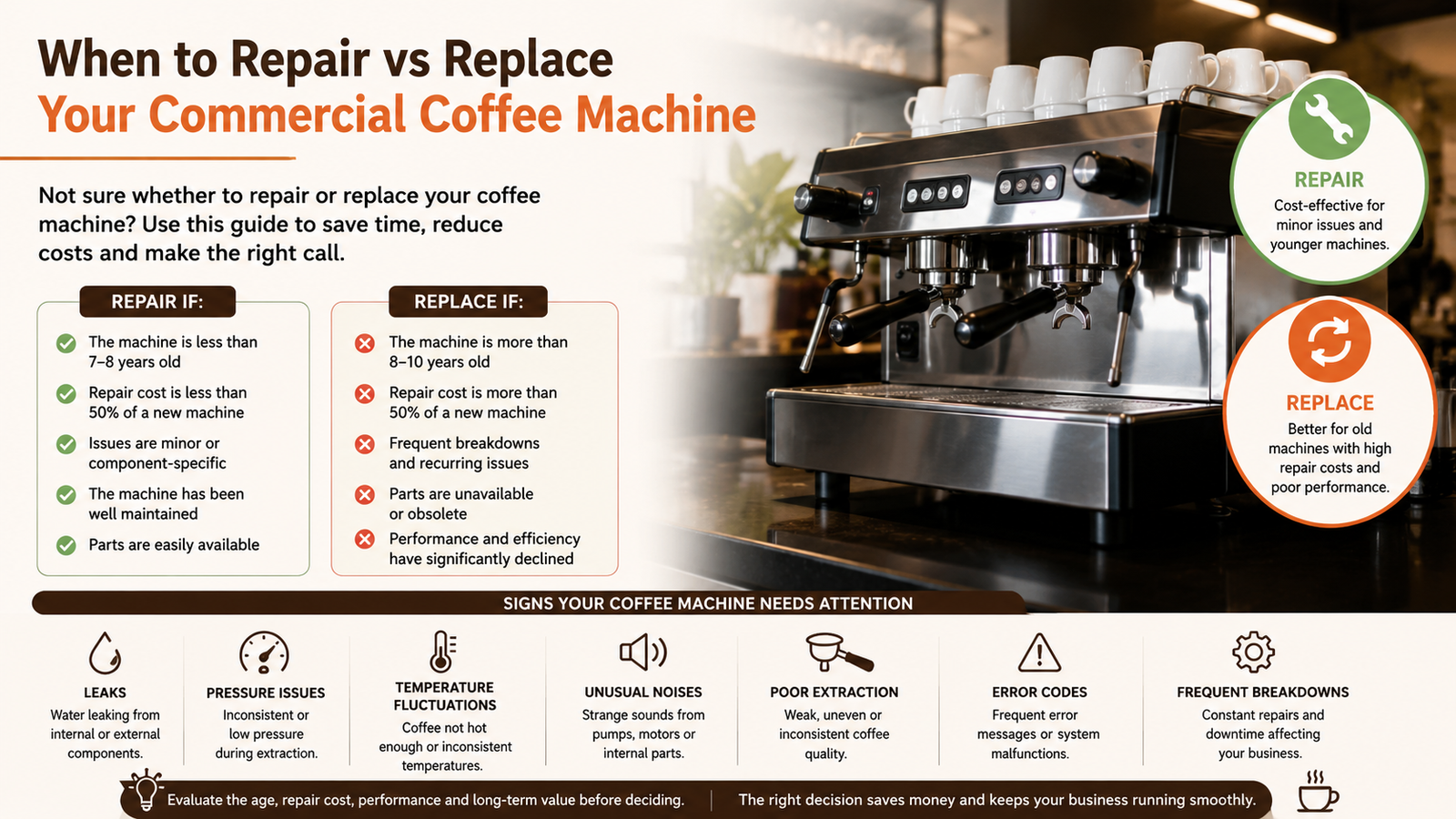
Start With the Age of the Machine
Age is often the first factor to consider.
0–5 Years Old
Most commercial coffee machines in this range are usually worth repairing.
Advantages include:
- Parts availability
- Modern technology
- Lower repair costs
A repair is often the most cost-effective solution.
5–8 Years Old
This is the evaluation stage.
Consider:
- Frequency of breakdowns
- Repair costs
- Machine performance
Repairs may still make sense if the machine has been well maintained.
8–10+ Years Old
Machines in this age range require closer analysis.
You should compare:
- Repair costs
- Energy efficiency
- Reliability
- Parts availability
Replacement often becomes the better option.
The 50% Rule
A widely used guideline in the equipment industry is the 50% Rule.
Ask yourself:
Does the repair cost exceed 50% of the price of a new machine?
If the answer is yes, replacement is usually the smarter investment.
Example
New machine cost:
₹2,00,000
Major repair estimate:
₹1,20,000
In this case, replacement is typically the better long-term decision.
When Repairing Makes Sense
There are many situations where repair is the right choice.
Minor Component Failures
Examples:
- Solenoid valves
- Pumps
- Gaskets
- Steam wand components
These are normal wear items and are often inexpensive to replace.
Machine Is Relatively New
If your machine is less than 5 years old and otherwise performs well, repairs are usually worthwhile.
Parts Are Easily Available
Readily available spare parts reduce downtime and repair costs.
Good Maintenance History
Machines that have been properly maintained often continue operating reliably after repairs.
Signs You Should Repair
One-Time Breakdown
The machine has a single isolated issue.
Stable Coffee Quality
Performance remains consistent apart from the current fault.
Low Repair Cost
Repairs are affordable relative to replacement.
Minimal Downtime
The machine can be restored quickly.
Reliable Service Support
Technicians and spare parts are readily available.
In these situations, repair is usually the best option.
When Replacement Makes More Sense
Sometimes continuing to repair a machine becomes more expensive than replacing it.
Frequent Breakdowns
If repairs are becoming routine, costs quickly add up.
Examples:
- Monthly service calls
- Repeated component failures
- Recurring electrical issues
Frequent downtime impacts business operations.
Declining Coffee Quality
Older machines may struggle to maintain:
- Pressure consistency
- Temperature stability
- Extraction quality
When quality declines permanently, replacement should be considered.
Obsolete Parts
Some older models become difficult to support.
Problems include:
- Long waiting periods for parts
- High spare part costs
- Discontinued components
Lack of parts can make repairs impractical.
High Energy Consumption
Older machines are often less efficient.
A modern machine may significantly reduce:
- Electricity usage
- Water consumption
- Maintenance requirements
These savings contribute to long-term ROI.
Warning Signs That Replacement Is Needed
Watch for these indicators:
Multiple Repairs Per Year
Constant repairs suggest deeper issues.
Major Boiler Problems
Boiler replacements can be extremely expensive.
Severe Corrosion
Internal corrosion affects reliability and safety.
Persistent Leaks
Recurring leaks often indicate aging systems.
Poor Temperature Control
Temperature instability directly impacts coffee quality.
Unavailable Spare Parts
Repairs become difficult and expensive.
If several of these issues are present, replacement is often the better choice.
Hidden Costs of Keeping an Old Machine
Many owners focus only on repair invoices.
However, older machines create hidden costs.
Lost Sales
Downtime means missed orders.
Customer Complaints
Poor coffee quality affects reputation.
Staff Frustration
Unreliable equipment slows operations.
Emergency Repair Costs
Urgent service visits are often expensive.
Increased Utility Bills
Older machines may consume more energy.
These hidden costs should be included in your decision.
Benefits of Replacing an Old Machine
Improved Coffee Quality
Modern machines offer better consistency.
Better Energy Efficiency
Reduced operating costs.
Faster Service
Improved workflow and productivity.
Advanced Features
Examples include:
- Programmable settings
- Digital controls
- Improved temperature management
Lower Maintenance Costs
New equipment typically requires fewer repairs.
Questions to Ask Before Deciding
Before making a decision, ask:
- How old is the machine?
- How much will the repair cost?
- How often does it break down?
- Are spare parts readily available?
- Is coffee quality declining?
- How much downtime does the machine create?
- Would a new machine improve efficiency?
Answering these questions provides clarity.
Sample Scenarios
Scenario 1: Repair
Machine age:
3 years
Problem:
Faulty pump
Repair cost:
₹10,000
Recommendation:
Repair
The machine is relatively new and the repair cost is low.
Scenario 2: Replace
Machine age:
10 years
Problems:
Boiler failure, temperature instability, multiple repairs
Repair estimate:
₹1,50,000
Recommendation:
Replace
A new machine provides better long-term value.
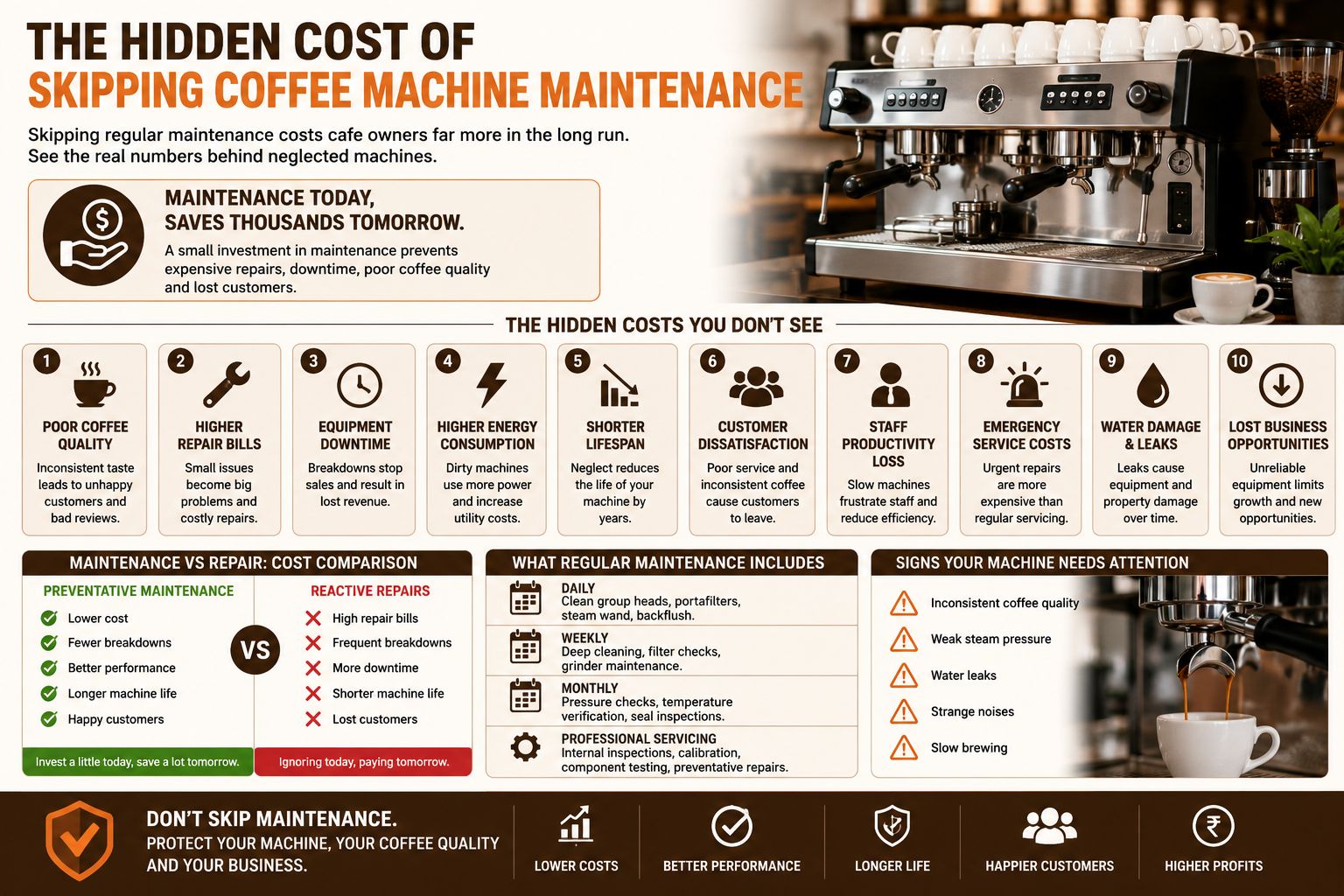
How Preventive Maintenance Delays Replacement
Regular maintenance can significantly extend equipment life.
Benefits include:
- Fewer breakdowns
- Better coffee quality
- Lower repair costs
- Longer lifespan
Many machines remain productive for years longer when properly maintained.
Why Successful Cafés Evaluate Total Cost of Ownership
The best café owners look beyond repair bills.
They evaluate:
- Reliability
- Energy efficiency
- Downtime costs
- Maintenance expenses
- Customer experience
This broader perspective often leads to better business decisions.
Why Neelkanth Enterprise Helps Businesses Make Smart Equipment Decisions
At Neelkanth Enterprise, we help cafés, restaurants, hotels, and food service businesses evaluate equipment performance and long-term value.
Our goal is to help customers:
- Reduce operating costs
- Improve reliability
- Maximize equipment lifespan
- Make informed replacement decisions
The right decision today can save significant money tomorrow.
Conclusion
Deciding whether to repair or replace a commercial coffee machine isn’t always easy. However, evaluating factors such as age, repair costs, reliability, performance, and spare part availability can help you make the right choice.
In general, newer machines with minor issues are worth repairing, while older machines with frequent breakdowns and expensive repairs often justify replacement.
The key is to focus on long-term value rather than short-term cost.
A reliable coffee machine keeps customers happy, improves efficiency, and supports the continued growth of your business.
FAQs
How do I know if my coffee machine should be replaced?
If repairs are frequent, parts are unavailable, and performance continues to decline, replacement is usually the better option.
What is the 50% Rule?
If a repair costs more than 50% of the price of a new machine, replacement should be seriously considered.
How long should a commercial coffee machine last?
Most quality commercial coffee machines last between 7 and 12 years with proper maintenance.
Are older coffee machines less efficient?
Yes. Newer machines often provide better energy efficiency and lower operating costs.
Can preventative maintenance delay replacement?
Absolutely. Regular maintenance can extend equipment lifespan and reduce the need for early replacement.