Opening a restaurant in India requires careful planning, and one of the biggest investments you’ll make is in commercial kitchen equipment. Unfortunately, many first-time restaurant owners make expensive equipment decisions that hurt profitability, slow operations, and create maintenance headaches.
The right equipment can improve food quality, speed up service, reduce costs, and help your restaurant grow. The wrong equipment can drain your budget before your business even gets established.
In this guide, we’ll discuss the five most common equipment mistakes new restaurant owners make and how you can avoid them.
Why Equipment Decisions Matter
Commercial kitchen equipment affects nearly every aspect of restaurant operations.
It impacts:
- Food quality
- Service speed
- Staff productivity
- Utility costs
- Customer satisfaction
- Long-term profitability
Making informed equipment choices from the beginning can save lakhs of rupees over time.
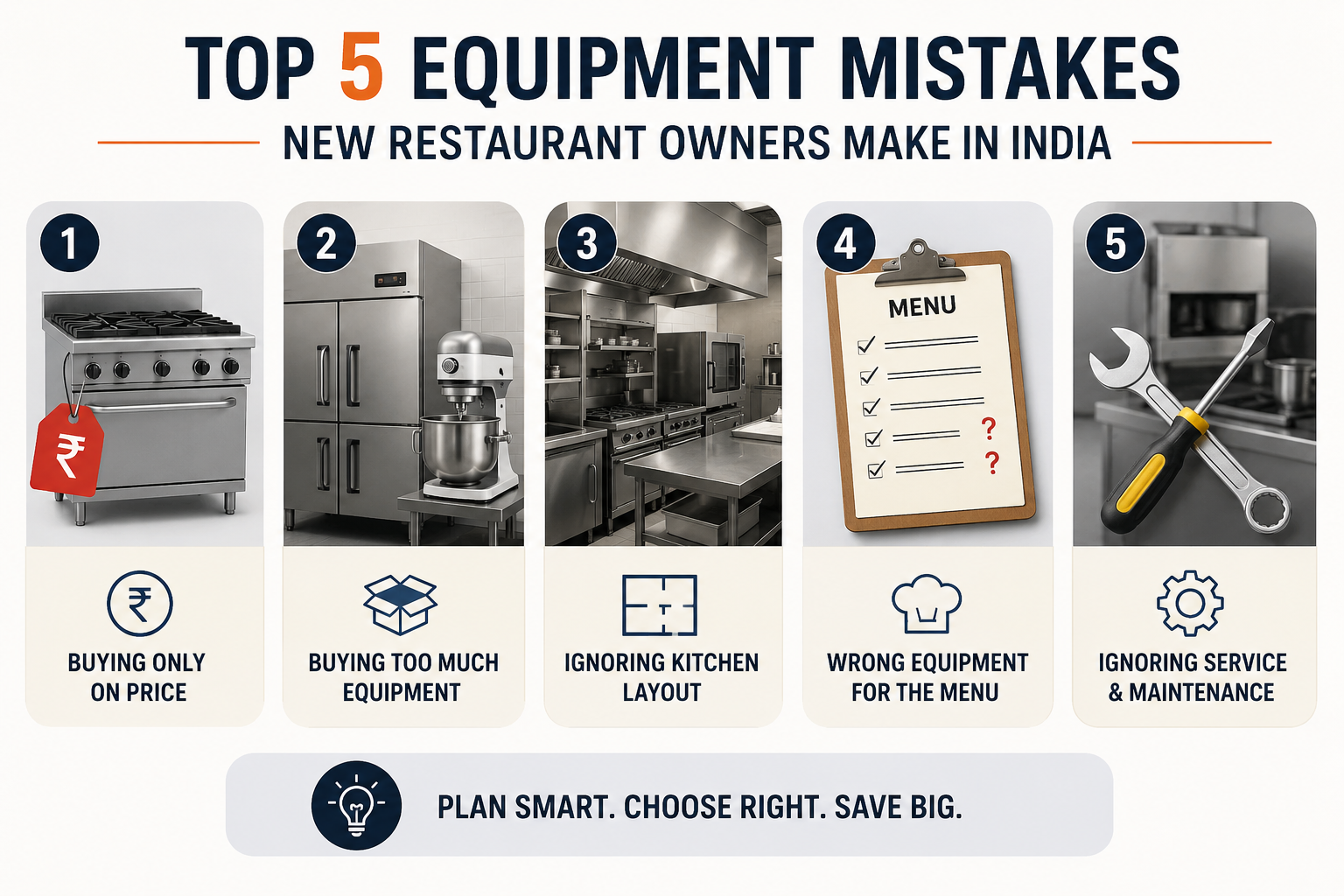
Mistake #1: Buying Equipment Based Only on Price
This is perhaps the most common mistake new restaurant owners make.
Many entrepreneurs try to minimize startup costs by purchasing the cheapest equipment available.
While this may seem like a smart decision initially, it often leads to:
- Frequent breakdowns
- Higher repair costs
- Inconsistent food quality
- Reduced productivity
- Shorter equipment lifespan
Example
A low-cost pizza oven may save money upfront but require repeated repairs within a year.
Meanwhile, a quality commercial oven may operate reliably for years with minimal maintenance.
Better Approach
Focus on:
- Reliability
- Warranty support
- Brand reputation
- Service availability
- Long-term value
Always calculate the total cost of ownership, not just the purchase price.
Mistake #2: Buying Too Much Equipment Too Early
Many restaurant owners purchase equipment for future growth before they actually need it.
Examples include:
- Extra ovens
- Additional refrigerators
- Multiple coffee machines
- Excessive storage equipment
This creates several problems:
- Higher startup costs
- Reduced cash flow
- Unused equipment
- Increased maintenance needs
Better Approach
Buy equipment based on current operational requirements.
Expand gradually as customer demand grows.
Investing in equipment you actually use is more profitable than purchasing equipment that sits idle.
Mistake #3: Ignoring Kitchen Layout Planning
Even high-quality equipment performs poorly when placed in an inefficient kitchen.
Common layout mistakes include:
- Poor workflow design
- Insufficient preparation space
- Long walking distances
- Congested work areas
These issues lead to:
- Slower service
- Staff frustration
- Lower productivity
- Increased labor costs
Better Approach
Design your kitchen around workflow.
Organize stations logically:
- Storage
- Preparation
- Cooking
- Service
A well-planned kitchen improves efficiency without spending additional money.
Mistake #4: Choosing the Wrong Equipment for the Menu
Many owners buy equipment before finalizing their menu.
This often leads to:
- Unused equipment
- Operational limitations
- Additional expenses later
Example
A cafe may invest heavily in bakery equipment but later focus primarily on coffee and sandwiches.
The result is wasted capital.
Better Approach
Finalize your menu first.
Then select equipment based on:
- Production requirements
- Capacity needs
- Menu complexity
Equipment should support your menu, not dictate it.
Mistake #5: Ignoring Maintenance and Service Support
Many buyers focus on equipment features but overlook after-sales support.
When problems occur, they discover:
- Spare parts are unavailable
- Service technicians are difficult to find
- Repairs take weeks
This creates costly downtime.
Consequences
- Lost sales
- Customer dissatisfaction
- Operational disruptions
Better Approach
Before purchasing, ask:
- Is local service available?
- Are spare parts readily available?
- What warranty is included?
- How quickly can repairs be completed?
Reliable support is just as important as the equipment itself.
Additional Equipment Mistakes to Avoid
Buying Used Equipment Without Inspection
Used equipment can be valuable, but only if properly evaluated.
Always inspect:
- Condition
- Performance
- Service history
Ignoring Energy Efficiency
Inefficient equipment increases:
- Electricity bills
- Operating costs
Modern equipment often saves money over time.
Underestimating Refrigeration Needs
Poor refrigeration planning can lead to:
- Food spoilage
- Inventory losses
- Operational challenges
Always calculate storage requirements carefully.
How Equipment Mistakes Affect Profitability
Equipment mistakes impact:
Revenue
Poor performance affects customer satisfaction.
Costs
Repairs and downtime increase expenses.
Productivity
Staff work slower with unreliable equipment.
Growth
Operational limitations restrict expansion.
Small mistakes often become large financial problems.
Signs You Purchased the Wrong Equipment
Watch for:
- Frequent breakdowns
- Slow production
- Staff complaints
- High utility bills
- Consistent maintenance issues
Identifying problems early allows corrective action before losses increase.
Equipment Categories That Deserve Extra Attention
Commercial Coffee Machines
Directly affect beverage quality.
Pizza Ovens
Critical for consistency and speed.
Refrigeration Systems
Essential for food safety.
Cooking Equipment
Impacts productivity and menu execution.
Food Preparation Equipment
Supports efficient operations.
These categories typically justify investing in higher-quality equipment.
How Successful Restaurant Owners Approach Equipment Purchases
Experienced operators focus on:
- Long-term value
- Reliability
- Service support
- Operational efficiency
- Scalability
They view equipment as an investment rather than an expense.
This mindset often leads to stronger financial performance.
Why Neelkanth Enterprise Helps Restaurants Avoid Costly Mistakes
At Neelkanth Enterprise, we help restaurants, cafes, bakeries, and cloud kitchens choose equipment that matches their business goals and operational requirements.
We assist with:
- Commercial coffee machines
- Pizza ovens
- Refrigeration systems
- Commercial kitchen planning
Our objective is helping businesses invest wisely and avoid expensive equipment mistakes.
Conclusion
Equipment decisions can significantly influence the success of a restaurant.
The five most common mistakes include:
- Buying based only on price
- Purchasing too much equipment
- Ignoring kitchen layout
- Choosing equipment before finalizing the menu
- Overlooking service and maintenance support
Avoiding these mistakes helps improve efficiency, reduce costs, and create a stronger foundation for long-term growth.
The best equipment isn’t necessarily the cheapest or the most expensive—it’s the equipment that best supports your business goals.
FAQs
What is the biggest equipment mistake new restaurant owners make?
Buying equipment based solely on price rather than long-term value is one of the most common mistakes.
Should I buy all equipment before opening?
Only purchase equipment required for your current operations and menu.
How important is service support?
Extremely important. Reliable service reduces downtime and protects profitability.
Is used restaurant equipment a good option?
It can be, but only after careful inspection and evaluation.
Why should kitchen layout be planned before buying equipment?
A proper layout improves workflow, productivity, and overall kitchen efficiency.